BIG Skate School Curriculum
Discover what awaits you during BIG Skate School with information below from Learn to Skate USA. With youth through adult options for beginners through advanced skaters, there's something for everyone at Skate School!
After you've looked this over, head back to the Bloomington Ice Garden web page to sign up for instruction.
If you have questions or need additional information, contact Rene Gelecinskyj, Skate School Coordinator at 952-563-4626 or rgelecinskyj@bloomingtonmn.gov
The First Day of Skating
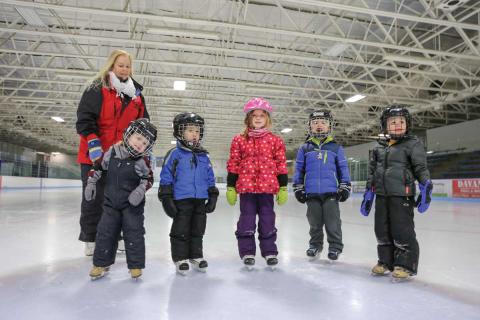
We’re going to let you in on a little secret. The first time you skate—you’re going to fall. We all fall. Olympic medalists have fallen hundreds of times. Thousands even. The best part, everyone gets right back up better than ever.
Anything is possible on your first day, but you can be ready for it. Prepare yourself with this guide for whatever expected and unexpected happens. You’ll feel comfortable. You’ll have safety in mind. And you’ll have more fun knowing you’re comfortable and safe. Your first day will then be a fantastic day. Just like the hundreds coming after it.
Show up a good 20 minutes before class kicks off.
Free rental skates are available for enrolled participants. Rolling racks of skates are available in the rink lobby.
Safety Helmets
All beginning skaters should wear them. The Consumer Products Safety Commission offers guidelines regarding different activities. Skaters should use one of these recommended helmets: ASTM F1447; Snell B-90A, B-95, N-94. Check the fine print for certifications.
Do
- Make sure the helmet fits comfortably and snugly.
- Wear the helmet low in front to protect the forehead.
- Keep it level and immobile. Avoid tilting back or pulling low.
- Secure chinstrap buckle. Check the adjustment often for protection, in case of a fall or collision.
- Replace your helmet immediately if signs or damage are visible.
- Clean the helmet with mild soap and water only.
- Store the helmet in a cool, dry place.
- Have the skater present during helmet purchase to test and ensure a good fit.
Don’t
- Wear anything under the helmet.
- Attach anything to the helmet.
- Wear a helmet that does not fit or cannot be adjusted properly.
- Leave a helmet in direct sunlight or in a car on a sunny day.
Clothing
Comfort and the ability to move about freely is an absolute must for skaters.
Jackets and Layers
- Layers along with a lightweight to medium-weight jacket should be worn.
- While it’s easy to assume it’s warmer indoors, arenas do keep thermostats set at a brisk 50 degrees.
- Sweatpants or warm-up pants are better than bulkier snow pants.
- Skaters may discard layers as they get warmer.
Gloves and Mittens
- They’re not just to keep your hands warm, they also protect hands as skaters learn to fall and stand back up.
- Lost and found boxes sometimes hide a few extra pairs skaters could borrow, if they forgot to bring some.
Socks
- As for feet, one pair of lightweight socks or thinner tights work best.
- Bulky, thick socks limit support and create uncomfortable bumps inside your skates.
Skates
Fitting Skates
- Try on skates until the most comfortable pair is found. The rule of thumb: The closer the fit, the more control. Skates should not fit too large.
- Skates should be snug, giving toes just enough wiggle room without pinching.
- Feet should be immobile with the heel far back in the boot.
- Solid support is also necessary because staying upright takes a considerable amount of strength.
- Note: Be aware that rental skates are designed to fit everyone. Shoe size does not necessarily match skate size.
- Lacing Skates: First tap the heel way back into the boot. Gently pull the tongue up and secure it straight up and down before tucking it beside the foot. Pull the second or third sets of laces from the bottom tightly to close the boot well over the front of the foot.
Laces should be snug through the ankle area and bottom two sets of hooks. The top two hooks can be a little looser to keep the ankle flexible. Cross extra laces over hooks neatly. Avoid winding it around the skates as loose flying bows often lead to accidents.
Now test it. Stick a finger between the back of the boot and leg to show skates were well laced. If the skate hurts or feels uncomfortable, re-lace and adjust. Practice walking in skates before entering the ice.
- Lacing Skates: First tap the heel way back into the boot. Gently pull the tongue up and secure it straight up and down before tucking it beside the foot. Pull the second or third sets of laces from the bottom tightly to close the boot well over the front of the foot.
Be Patient
Group classes are great for building a solid foundation for developing skills. There are no shortcuts or fast tracks. Everyone progresses at their own rate. Some skills will come easier than others.
Be Polite
Think about the safety of other student skaters in the class. Stay in control and within boundaries of the class to avoid interfering with others. Skaters should:
- Maintain a smart, safe distance from other skaters.
- Maintain a safe speed.
- Stay with the class and instructor in their designated ‘classroom’ area.
Recognize Class and Session Expectations
Parents can observe classes of all levels, skills and ages from the stands or designated areas. You should avoid standing in doorways or near the players’ benches.
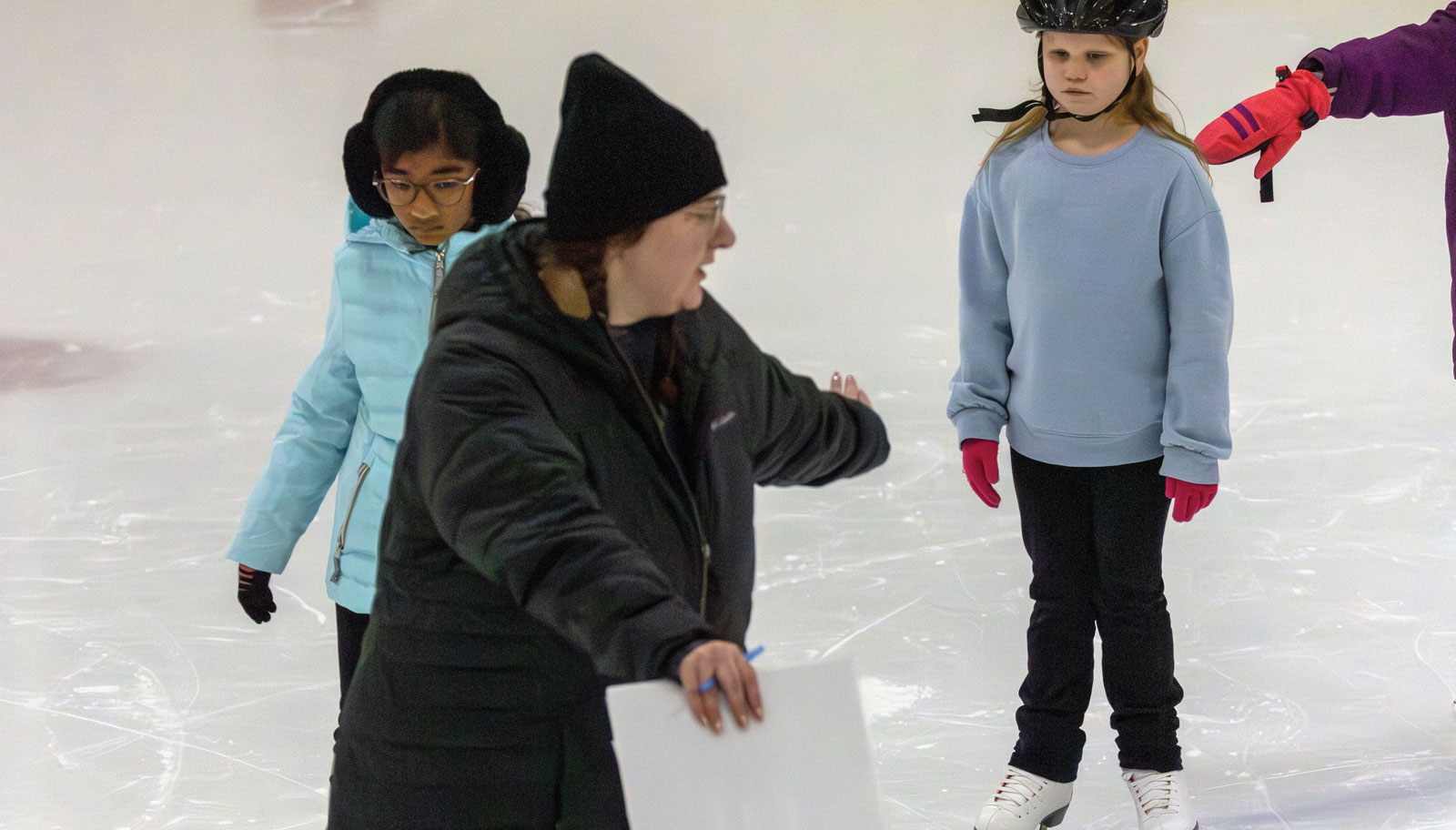
For beginners, marching across the ice is the first skill taught. Some skaters push and glide with ease. Others will be more cautious by taking baby steps, and that’s good. Learning to fall and stand right back up will also take precedence. Instructors will spend time during each lessons perfecting this skill.
After a few classes, beginning skaters will start to gain confidence and start to demonstrate the ability to skate reasonably well on their own, get up from falling, and attempt to stop while moving slowly.
Repeating a class is not unusual for skaters. All skills need to ladder up to one another in order to move skaters up the next level, so mastering skills first is necessary. Instructors will provide written feedback on skater’s progress. This should include accomplishments, opportunities to improve, and recommendations on which class to register for next. These evaluations will be given during the final class of the session. If you are absent the last day, the evaluation will be mailed to the address on your family account. Make sure your contact information is accurate and complete.
Makeup Policy
Makeup lessons are generally not available. However, you may ask the Skate School coordinator if there might be an option available.
Set Up Supplemental Private or Semi-Private Lessons
For those seeking more attention, you may hire a coach for a private lesson. A booster lesson may be a good thing if assistance is needed to master a specific skill. If interested, inquire about private lessons with the Skate School coordinator. There are also options to further advance your skating skills with the Figure Skating Club of Bloomington.
Set Up Extra Practice Time
Practicing is the road to improving. Before and/or after each lesson, skaters should practice the skills learned during lessons. Use public skating sessions or ask if there are club-sponsored or skating sessions open. Obtain a list of things to practice from the instructor, or bring a record book to write down what needs improvement.
The Curriculum
Learn more about the Skate School class curriculum in the tabs below.
Discover, learn and play. The Snowplow Sam levels are introductory classes divided into four progressive levels allowing children with no prior skating experience to build confidence while learning the basic skills of skating. These classes are designed to help children six and younger develop the ABCs of movement: agility, balance, coordination and speed. The ABCs are essential for developing fundamental movement skills and physical literacy. All classes will be taught in a safe and positive environment, incorporating fun and games making class time an enjoyable experience for all.
Snowplow Sam 1
- Sit and stand up with skates on (off-ice)
- Sit and stand up (on-ice)
- March in place
- March forward (8-10 steps)
- March, then glide on two feet
- Dip in place
Snowplow Sam 2
- March followed by a long glide
- Dip while moving
- Backward walking, toes turned inward, shifting weight (4-6 steps)
- Backward wiggles (6 in a row)
- Forward swizzles (2-3 in a row)
- Beginning snowplow stop motion, in place or holding onto barrier
- Two-foot hop, in place (optional)
Snowplow Sam 3
- Forward skating (8-10 steps)
- Forward one-foot glide, one time skater’s height (R and L)
- Forward swizzles (4-6 in a row)
- Backward two-foot glide
- Backward swizzles (2-3 in a row)
- Moving forward snowplow stop (1 or 2 feet)
- Curves
Snowplow Sam 4
- Forward skating
- Advanced one-foot glide, two times skater’s height
- Backward swizzles (4-6 in a row)
- Rocking horse – one forward, one backward swizzle, repeat twice
- Two-foot turns in place - forward to backward (both directions)
- Two-foot hop in place
Based on the age and ability of the child after completion of Snowplow Sam 3, he/she can successfully advance to Basic 2 or Hockey 2, or progress to Snowplow Sam 4.
Basic Skills teaches the FUNdamentals of ice skating and provides the best foundation for figure skating, hockey and speed skating. Six progressive levels introduce forward and backward skating, stops, edges, crossovers and turns. Upon completion of the Basic Skills 1-6 levels, skaters will be able to confidently advance to more specialized areas of skating. All classes will be well-structured with the focus on proper skill development taught in a positive, FUN and social environment. Skaters will progress at their own rate and advance after skill mastery is demonstrated.
- Discover, Learn and Play – Basic 1 and 2: These introductory levels allow new skaters with little skating experience to build confidence while learning to skate.
- FUNdamentals – Basic 3–6: These levels develop all of the fundamental skating skills on the ice. Focus is on learning the ABCs of basic athleticism: agility, balance, coordination and speed. Upon completion of these levels, skaters will be able to confidently advance to more specialized areas of skating.
Basic 1
- Sit on ice and stand up
- March forward across the ice
- Forward two-foot glide
- Dip
- Forward swizzles (6–8 in a row)
- Backward wiggles (6–8 in a row)
- Beginning snowplow stop (on one or two feet)
Bonus Skill: Two-foot hop in place
Basic 2
- Scooter pushes (R and L)
- Forward one-foot glides (R and L)
- Backward two-foot glide, length of skater’s height
- Rocking horse — one forward swizzle, one backward swizzle (repeat twice)
- Backward swizzles (6–8 in a row)
- Two-foot turns from forward to backward in place (clockwise and counterclockwise)
- Moving snowplow stop
Bonus Skill: Curves
Basic 3
- Beginning forward stroking showing correct use of blade
- Forward half-swizzle pumps on a circle — 6–8 consecutive clockwise and counterclockwise
- Moving forward to backward two-foot turns on a circle (clockwise and counterclockwise)
- Beginning backward one-foot glides — focus on balance
- Backward snowplow stop (R and L)
- Forward slalom
Bonus Skill: Forward pivots (clockwise and counterclockwise)
Basic 4
- Forward outside edge on a circle (R and L)
- Forward inside edge on a circle (R and L)
- Forward crossovers — clockwise and counterclockwise (4-6)
- Backward half-swizzle pumps on a circle — 6-8 clockwise and counterclockwise
- Backward one-foot glides (R and L)
- Beginning two-foot spin (up to two revolutions)
Bonus Skill: Forward lunges — both legs
Basic 5
- Backward outside edge on a circle (R and L)
- Backward inside edge on a circle (R and L)
- Backward crossovers — 4-6 clockwise and counterclockwise
- Forward outside three-turn (R and L)
- Advanced two-foot spin, min. 4 revolutions
- Hockey stop — both directions
Bonus Skill: Side toe hop (R and L)
Basic 6
- Forward inside open mohawk from a standstill (R to L and L to R)
- Forward inside three-turn (R and L)
- Moving backward to forward two-foot turn on a circle — clockwise and counterclockwise
- Backward stroking
- Beginning one-foot spin, optional free leg and entry position (2-4 revolutions)
- T-stops (R and L)
- Bunny hop
- Forward spiral on a straight line (R and L)
Bonus Skill: Shoot the duck (R and L)
Each free skate level is comprised of a variety of progressive skating skills, transitions, spins and jumps — all of which build on the previous skill, providing skaters a strong foundation of all elements. These levels will be taught in a positive and interactive group format such as an Aspire program, circuit classes or as an introductory training program.
Instructors will focus on quality and mastery of skills. Skaters need to have passed Basic 6 prior to enrolling in Pre-Free Skate.
Pre-Free Skate
Combination of Basic 7 and 8.
- Skating Skills
- Backward crossovers to a backward outside edge glide (landing position), clockwise and counterclockwise
- Backward outside edge to a forward outside edge transition on a circle (R and L)
- Two forward crossovers into a forward inside mohawk, step down and cross behind, step into one backward crossover and step to a forward inside edge, repeat three times clockwise and counterclockwise
- Spins
- One-foot upright spin (USp), optional entry and free-foot position (minimum three revolutions)
- Jumps
- Mazurka (R and L)
- Waltz jump (1Wz)
Bonus Skill: Backward inside pivots, clockwise and counterclockwise
Free Skate 1
- Skating Skills
- Forward power stroking, clockwise and counterclockwise
- Basic forward outside and forward inside consecutive edges (4-6)
- Backward outside three-turns (R and L)
- Spins
- Upright spin (USp), entry from back crossovers (min. four revolutions)
- Jumps
- Half flip (1HF)
- Toe loop (1T)
Bonus Skill: Waltz jump-waltz jump sequence (1Wz+1Wz)
Free Skate 2
- Skating Skills
- Alternating forward outside and inside spirals on a continuous axis (two sets)
- Basic backward outside and backward inside consecutive edges (4-6)
- Backward inside three-turns (R and L)
- Spins
- Beginning back spin (USp) (min. 1-2 revolutions)
- Jumps
- Half Lutz (1HLz)
- Salchow (1S)
Bonus Skill: Variation of a forward spiral, skater’s choice
Free Skate 3
- Skating Skills
- Alternating backward crossovers to back outside edges (4 sets)
- Alternating mohawk/crossover sequence (R to L and L to R)
- Waltz three-turns (forward outside three-turn, backward outside edge glide), clockwise and counterclockwise
- Spins
- Advanced back spin (USp) with free foot in crossed leg position (min. three revolutions)
- Jumps
- Loop jump (1Lo)
- Waltz jump-toe loop (1Wz+1T) or Salchowtoe loop (1S+1T) combination
Bonus Skill: Toe step sequence, skater’s choice, using a variety of toe steps
Free Skate 4
- Skating Skills
- Forward power three-turns, 3 sets each (R and L)
- Waltz eight
- Spins
- Forward upright spin (USp) to backward upright spin (USp) (3 revs. each foot)
- Sit spin (SSp) (min. three revolutions)
- Jumps
- Half loop (1HLo)
- Flip (1F)
Bonus Skill: Split jump, stag jump or split falling leaf
Free Skate 5
- Skating Skills
- Backward outside three-turn, mohawk (backward power three-turns), clockwise and counterclockwise
- Five-step mohawk sequence, clockwise and counterclockwise
- Spins
- Camel spin (CSp) (min. three revolutions)
- Jumps
- Waltz jump-loop jump combination (1Wz+1Lo)
- Lutz jump (1Lz)
Bonus Skill: Loop-loop combo (1Lo+1Lo)
Free Skate 6
- Skating Skills
- Forward power pulls (R and L)
- Choreographic step sequence (ChSt), skater’s choice, using a variety of threeturns, mohawks and toe steps
- Spins
- Camel-sit spin combination (CoSp) (min. two revolutions each position)
- Layback (LSp), attitude or cross-foot spin (USp) (three revolutions)
- Jumps
- Waltz jump-Euler-Salchow jump sequence (1Wz+1Eu+1S)
- Beginning Axel (1A)
Bonus Skill: Backward outside pivot (optional entry)
Note: Skate School has the authority to add classes to continue skater development under the umbrella of Learn to Skate USA beyond Free Skate 6.
The Adult curriculum is designed for both beginning and experienced adult skaters who wish to improve their skating skills. Participation in the program will help promote physical fitness and improve balance and coordination while teaching proper skating techniques. This is an exciting program for people who look to skating as an enjoyable part of a fit and healthy lifestyle.
Divided into six levels from basic skating to more advanced skills, adult skaters will progress at an individual rate while being challenged and motivated. Based on prior skating experience, adults may choose to begin at the level that best matches their skill base.
- Off-ice orientation:
- Equipment check - proper fit and lacing of skates, appropriate attire, safety concerns
- Practice falling and recovery, walking in place, knee bends and one-foot balances in skates
Adult 1
- Falling and recovery on ice
- Forward marching
- Forward two-foot glide
- Forward swizzles (4-6 in a row)
- One forward swizzle/one backward swizzle (rocking horse)
- Dip
- Forward snowplow stop (one or two feet)
Adult 2
- Forward skating across the width of the ice
- Forward one-foot glides (R and L)
- Forward slalom
- Backward wiggles
- Backward swizzles (4-6 in a row)
- Two-foot turns in place
Adult 3
- Forward stroking with proper blade use (begin with repetitive one-foot pushes)
- Forward half-swizzle pumps on the circle, clockwise and counterclockwise (6-8 in a row)
- Moving forward to backward and backward to forward two-foot turn on a circle, clockwise and counterclockwise
- Backward skating into a long two-foot glide
- Forward chasses on a circle, clockwise and counterclockwise
- Backward snowplow stop (R and L)
Adult 4
- Forward outside edge on a circle (R and L)
- Forward inside edge on a circle (R and L)
- Forward crossovers, clockwise and counterclockwise
- Backward one-foot glides (R and L)
- Backward half-swizzle pumps on a circle, clockwise and counterclockwise
- Hockey stop, both directions
Adult 5
- Backward outside edge on circle (R and L)
- Backward inside edge on a circle (R and L)
- Backward crossovers, clockwise and counterclockwise
- Forward outside three-turn (R and L)
- Forward swing rolls to a count of six
- Beginning two-foot spin
Adult 6
- Forward stroking with crossover end patterns
- Backward stroking with crossover end patterns
- Forward inside three-turn (R and L)
- Beginning power pull (R and L)
- T-stop (R or L)
- Lunge
- Two-foot spin into one-foot spin (USp)
Upon completion of the Adult 1-6 curriculum, adult skaters should feel confident with all fundamental skating skills and may choose to progress to more specialized areas of skating such as free skating, ice dancing, adult hockey leagues or synchronized skating.
Information about Ice Skates
Learn about different types of skates.
- Which ones are ideal for Skate School?
- How do you lace them up properly?
- What's the best way to care for them so they last a long time?
- What are some things to look for when buying skates?
View the tabs below to find the answers to these and other questions.

Which are better, figure skates or hockey skates for beginners?
Figure skates are generally better for beginner skaters because their design provides more stability, control, and balance during early skill development. The longer, flatter blade gives new skaters a larger surface area on the ice, making it easier to stand steadily and learn basic movements without feeling wobbly.
In contrast, hockey skates have shorter, more curved blades designed for speed and quick turns, which can feel less stable for someone just learning to skate. For these reasons, figure skates tend to support smoother progress and a safer, more comfortable learning experience in beginner lessons.
How to Tie and Care for Skates
- Tying Ice Skates
- Loosen all laces from the top to the toes before putting the skate on.
- Ensure the heel is pushed firmly to the back of the boot.
- Pull each pair of eyelets snug, starting at the bottom.
- Keep tension even as you lace upward.
- Tighten the ankle area the most for proper support.
- Lace hooks (if present) slightly looser to allow natural knee bend.
- Finish with a secure bow and double knot.
- Check for a snug fit, no heel lift, and comfortable knee bend.
- Caring for Ice Skates
- Wipe blades completely dry after each use.
- Use soft blade guards when walking off the ice.
- Never store skates with hard guards on.
- Put fabric soakers on blades to absorb moisture.
- Open the skate bag at home to allow skates to air dry.
- Loosen laces after skating to maintain boot shape.
- Check blades for rust, dullness, or damage.
- Sharpen blades as needed for safety and performance.
- Inspect screws, eyelets, and laces regularly.
When buying good‑quality ice skates, it’s important to choose a pair that provides proper support, durability, and a comfortable fit. Look for skates with a firm boot that doesn’t bend easily at the ankle—this gives new skaters the stability they need as they learn. Avoid low‑quality “recreational” skates that feel soft or flimsy, as they break down quickly and make skating more difficult.
Skates should fit snugly without pinching, with the heel sitting securely in the back of the boot. It’s also helpful to purchase skates from a reputable skate shop where staff can check sizing, blade alignment, and boot stiffness. Choosing well‑made skates helps skaters progress more easily, stay safer on the ice, and enjoy a better overall skating experience.
About Learn to Skate USA
Our mission is to provide a fun and positive experience that will instill a lifelong love of skating. With over 1,000 programs nationwide, Learn to Skate USA introduces beginning skaters to the fundamentals of ice skating. Through standardized curriculum endorsed by U.S. Figure Skating, USA Hockey and US Speedskating, skaters are better prepared to move on to more specialized forms of skating.