
Information - Utilities Division
The following handouts provide guides to some of the engineering requirements that govern a topic. For more information or for a physical handout, contact the Utilities Division at 952-563-8777 or by emailing Utilities@Bloomingtonmn.gov.
This is an overview of problems that occur in sanitary sewer services. This information focuses on 1960s construction and the materials used during that period when most sanitary sewer systems were installed. This information also outlines the type of failures that occur, how you can recognize those failures and what alternatives are available for making repairs.
What is a sanitary sewer service?
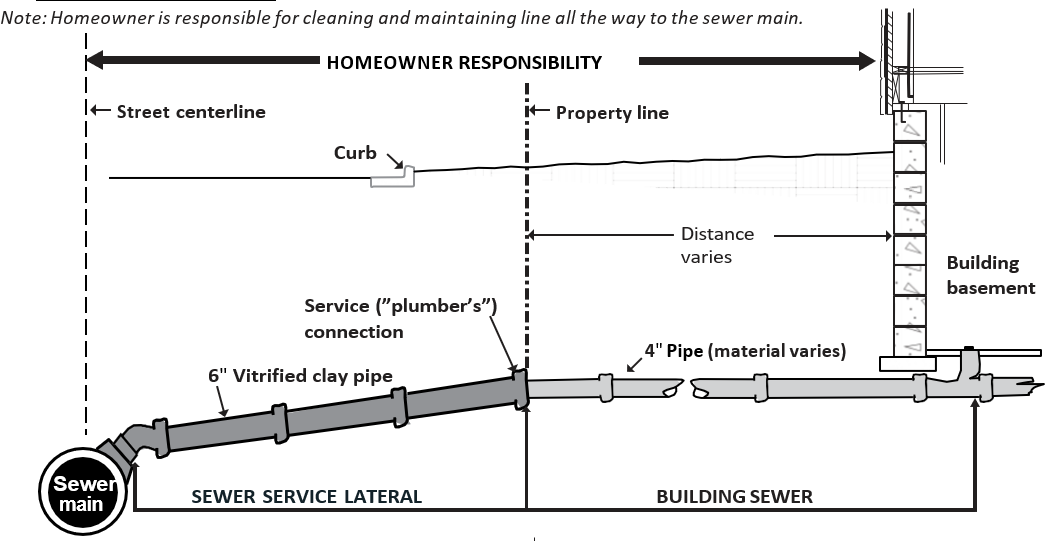
The sanitary sewer service connects the building to the sanitary mainline in the street. Sewer cleaners call the service line "the main." it has two components: the sewer service lateral and the building sewer. See illustration below.
The sewer coming from the building connects to the sewer service lateral at a point called the service connection or "plumber's connection." This connection was made when the building/home was originally built or when a septic system was abandoned and the building/home was connected to the City sewer. The tar compound commonly used in this joint during the 1960s tendsto shrink and is a primary source of failure resulting in tree root intrusion.
Bloomington City Code section 11.33 states, in part, "Each owner shall be responsible for maintaining, cleaning, repairing, and replacing of the sewer lateral from the house to the sewer main."
Sanitary sewer service
Recognizing the problem
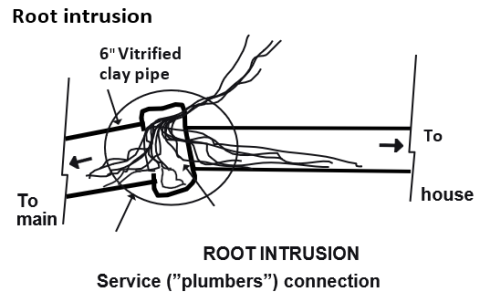
Although root intrusion can take place at any point in the service line, the service connection is one of the most common points where failure occurs. One way to evaluate this is to ask the sewer cleaning contractor questions about where they encounter problems during the cleaning process. If a sewer-cleaning contractor has commented that they have hit an obstruction near the property line, this may be the source of the obstruction. In many cases the roots mass has grown so large within the pipe that normal cleaning does not remove the roots but just temporarily relieves the stoppage by cutting a small hole in the root mass. In this case, excavating the line for repair may be necessary.
Repair and maintenance alternatives
A repair to your service line may not be required if you have the line cleaned periodically. If the root intrusion can be controlled by cleaning, it may be a cost-effective alternative to excavation and repair.
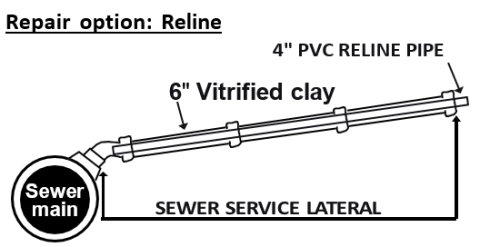
If a repair is required, the typical repair for root intrusion is at the "plumber's connection" which involves excavating the connection and removing the old pipe and the root mass that may be present. See previous illustration. Other types of repairs include replacing all or part of the service line. Another repair that minimizes excavation is called a "reline." This option improves the property owner's service line as it continues out to the City's mainline sewer without excavating in the street or yard. A "reline" is done by placing a 4-inch PVC pipe inside the 6-inch clay pipe and then connecting that 4-inch PVC pipe to the building pipe. It is the responsibility of the homeowner to determine which option is best suited for the particular problem in their service line.
Procedure for proceeding with a repair
A property owner is responsible for initiating any repairs or maintenance of their sewer service line. The City will assist the owner by providing information and history on their sewer service. This information is very important in evaluating the condition of the service.
If you are a property owner please contact the Utilities Division first before proceeding!
The owner may use any plumber licensed to work in the City of Bloomington to make the repair. The owner of homesteaded property may also do the work. This does not include hiring a non-licensed contractor. The procedure and permit requirements are the same in both cases. The city cannot recommend any specific contractor but owners are highly encouraged to get competitive bids.
Permits should be submitted through the cities permit portal by creating an account at https://permits.bloomingtonmn.gov/prodportal. When applying for a permit select the type as "Utility" and in the description of work be as descriptive with the work being done and when the work is planned to be completed.
- After a Utility permit is approved and issued by the Utilities division, the work may proceed with the repairs. Call for an inspection upon completion.
Utilities Contacts
Utilities Division................................ 952-563-8777
These are some common frequently asked questions related to home sewer services.
What is the property owner's responsibility?
The property owner is responsible for cleaning, maintaining, and repairing the lateral from the home to the City main, including the connection to the main.
Is my service affected by what I put down the drain?
Root intrusion is the most common cause of slow drainage or blockage. However, disposal of items such as grease, motor oil, eggshells, coffee grounds, and cat litter in toilets or garbage disposals frequently clogs the home sewer lateral and/or the main municipal sewer line and is prohibited. For a complete listing of prohibited items, see Bloomington City Code, Ch. 11.31 (b). Please never dispose of any prohibited items in storm drains.
What kinds of problems do fats, oils and grease cause?
A leading cause of sewer blockages across the U.S. is the accumulation of fats, oils, and grease (FOG) in sanitary sewer systems. Correcting a blockage can be expensive. If a blockage occurs in the City's collection system, the maintenance costs are covered by all sewer utility rate payers. The City of Bloomington has an ongoing, proactive sewer cleaning program that properly maintains the collection system. Minnesota courts have found that property damage resulting from a sewer backup into a private home or business cause by the illicit disposal of prohibited substances is each property owner's responsibility.
What can I do to prevent sewer backups from fats, oils and grease?
DO NOT pour fats, oils and grease from cooking down the drain. Collect the grease in a metal can (Soup cans work great), and once the grease has cooled and solidified, place it in the trash for disposal.
Useful facts about grease disposal:
- Garbage disposals do nothing to protect sewer lines from grease buildup. Use disposals sparingly.
- Dishwashing detergents do not protect sewer lines from grease buildup. While it is true that they initially break up the grease, they eventually lose this ability and grease will then accumulate in sewer lines.
- Chasing grease down the drain with hot water only causes the grease to buildup elsewhere.
What other items should not be put down the drain or flushed down the toilet?
Anything that will not totally dissolve and breakdown in water can cause a sewer blockage in residential and municipal lines. Besides the fats, oils, and grease mentioned above, paper towels, disposable diapers, sanitary napkins, bandages, rags, towels, underwear, panty hose, plastic bags, and cat litter should not be flushed.
What about periodic or preventive sewer cleaning by a homeowner or a contractor?
Periodic cleaning is recommended only in cases of a known problem, such as root intrusion. Consult a plumbing professional to determine the cause of the problem and determine the most cost effective solution for your situation.
Root intrusion problems
Root intrusion is the most common reason for slow drainage or a blockage. Management of chronic root problems can be expensive and difficult to schedule, as root activity can be unpredictable. The disposal of prohibited items in a sewer service can dramatically compound slow drainage or blockage. Items become tangled or lodged in a relatively small root mass and become a large blockage in a short time period. The most effective solution to root intrusion is evaluation by video camera and possible excavation and repair. The City urges residents to seek reputable contractors in such cases and request multiple estimates for any proposed work.
Questions not answered?
Call the Utilities Division.................... 952-563-8777
This is an overview of commercial and industrial use water meter's.
Setting and installation of 1-1/2, 2 and 3 inch meters
If a new meter is needed or a meter that is larger than 3 inches is needed please contact the Utilities Division.
- Meters must be set to be easily removed for repair or replacement.
- Meters shall be installed at the point of entry of the service into the building in a mechanical/utility room adjacent to a floor drain.
- A valve must be placed on the inlet and outlet side of the meter. Valves shall be full flow. Do not use angle, butterfly, or globe valves.
- All meters shall be installed no higher than three feet above the finished slab to the piping centerline and shall be clear of all adjacent obstructions by at least 12 inches. The clearance in front of the meter shall be at least 24 inches and the clearance above the meter shall be at least 48 inches.
All meters shall be mounted in a horizontal position and shall be supported by the adjacent piping. Piping connected to 1-1/2 inch and larger meters shall be supported directly adjacent to the meter and no piping shall place a transverse or longitudinal load on the meter.
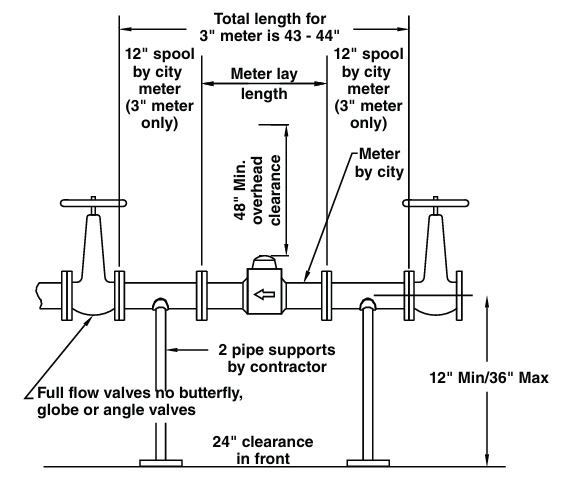
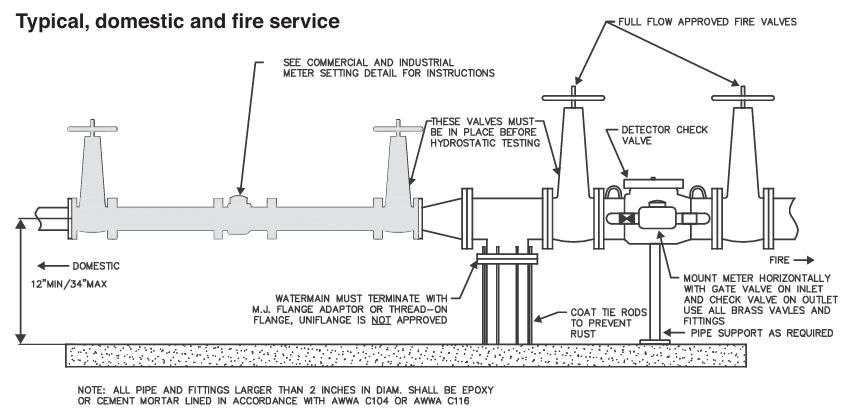
The above illustration shows 3" meter setting. 1-1/2" and 2" meters do not have spools on either side of the meter. Pipe support required on discharge side only of 1-1/2" and 2" meters, but both inlet and discharge sides of 3" meter. Observe clearances, pipe elevation restrictions and full flow valve requirements for all meter sizes.
Note: If you have any questions about setting meters, please call the Utilities Division at 952-563-8777 BEFORE plumbing meter.
Meter Size Meter lay length Threaded flanges furnished by the City 1-1/2"
13"

2"
17"

3"
19" + Spools = 43-44" total

This is an overview of fire service and detector meters.
Note: Detector check meters must have a gate valve on the inlet and a check on the outlet.
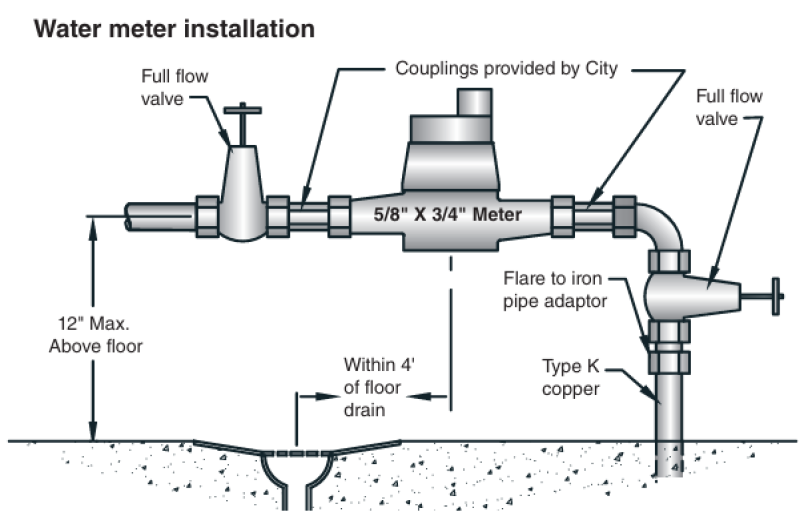
This is an overview of water meter installation information for residential meters.
Residential meter
- Each service shall be brought through the floor vertically with a full flow valve placed approximately 12 inches above the floor.
- A valve must be placed on the inlet and outlet side of the meter. Do not use angle, butterfly or globe valves.
- Meters shall be mounted horizontally and connected to the water line where it comes through the floor into the building.
- Meters shall be set in the laundry or furnace area. All meters shall be readily accessible for repair, reading, and replacement. No meters will be allowed in vaults, crawl spaces, ceilings or in confined or substandard spaces.
Residential touch pad installation
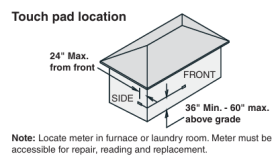
Touch pad's are located on the exterior portion of a building. It is what give the Utilities division a proper meter reading. The touch pad's can break either due to issues with the wiring or the pad itself. The city owns this equipment and is responsible for repairing and replacing.
Mount touch pad a minimum of 36 inches and a maximum of 60 inches above grade. Mount on the front or on the side a maximum of 24 inches from the front.
Note: The city is gradually moving away from touch pads and replacing them with radio reading devices.
Wiring
On the meter
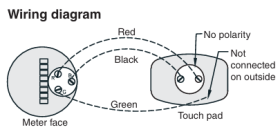
Connect the black and red wires to the meter using the "B" and the "R" terminals. Then connect the green wire to "G." This wire does not connect to outside.
On the touch pad
Wire the touch pad using the black and red wires, they are not polarity sensitive. The green wire is not connected on the outside (leave it tucked in behind the touch pad and do not trim it flush). Connect the wires to the pad before mounting it to the structure.
Call the Utilities Division for a meter inspection and water turn on after you have a new meter installed. We will also check and ensure that the curb stop/service valve is up to grade.
Utilities Division......... 952-563-8777
Monday - Friday, 7:30 am to 4:00 pm
This information will help you determine whether your home's plumbing system has inadequate water pressure or inadequate water flow. The problems are not the same, and the solutions are different.
Note: Issues with the internal plumbing or water service line under the homeowners jurisdiction is a private matter and the city has limited jurisdiction to assist with issues. Whenever you have water pressure issues always call the Utilities Division as we can assist and trouble shoot but if its a private issue the homeowner/property owner will need to contact a plumber.
Is it water pressure or water flow?
Water pressure, measured in pounds per square inch (PSI), is the force that pushes water through the system. In most cases this is determined by the elevation of your home in relationship to the elevation of the water tower. The Utilities Division cannot change your water pressure. The water system is designed to operate in a certain range of pressures and those values are fixed, by design.
Water flow, measured in gallons per minute (GPM), is what really matters when evaluating whether your home is getting enough water for your household needs. Flow is determined by the water pressure and the volume of the pipe, or pipe size. These two factors together are what you need to get the desired water flow. As an example, if you have old galvanized pipe that is full of scale, one component needed for optimal flow has been removed; the volume of water moving through the pipe has been reduced.
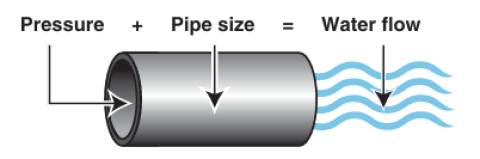
Actual water pressure measurements can be taken by placing a pressure gauge on your laundry tub or outside faucet while you are not using water elsewhere in the home. If your water pressure drops dramatically during water use, you may have an inadequately-sized water service or undersized water piping inside your home.
Normal system operating pressures
The chart below shows the different PSI levels. 60-70 PSI is optimal but generally any PSI number between 35-90 PSI is acceptable.
35 PSI | Adequate |
50 PSI | Typically well |
60 PSI | Optimal |
70 PSI | Optimal |
80 PSI | Pressure regulating valve needed |
90 PSI | High |
Tips to improve your water pressure
Do you have a water softener?
Water softeners can plug up and affect the pressures in our house, though they typically are not plumbed to the outside faucets. Many water softeners have bypass valves. Open the bypass valve if your pressure improves, the water softener is the culprit.
Is the problem only at one fixture?
This is a common problem with older fixtures. The pipe feeding the fixture or some part of the fixture itself could be plugged.
- Screens on faucets and the holes in shower heads can be come plugged.
- Dishwasher valves also have screens that plug and gaskets that malfunction.
- Humidifiers can plug up with scale and malfunction.
- The vacuum breaker device on your outside faucet can malfunction.
- Your lawn sprinkler can plug.
What can you do? Clean, repair or replace the fixture or device.
Do you have a whole house filter or an under-sink filter?
These are a common problem that can reduce pressure especially if the filter plugs up. Make sure that you are maintaining the filter element.
Do you have "Globe" type valves on your water service by the meter?
Check to see if both valves at the meter are fully open. Tip: Loosen the packing nut under the valve handle to help turn the valve - tighten when done to prevent leaks. These valves can cause a restriction in the flow of water into your home. Replacing these valves can improve the flow from the water service.
Note: These valves are the responsibility of the homeowner. The Utilities Division will not replace these valves.
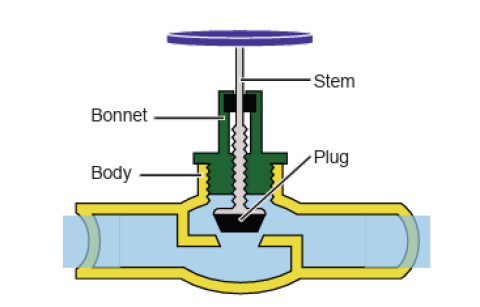 Diagram of a Globe Valve.
What to do? The replacement of the valve on the inlet side of the meter requires that the water be shut off at the "curbstop," which is in your front yard at the property line. If you wish to do the work yourself, call the Utilities Division to shut off the curbstop. If you have a plumber do the work, have them contact the Utilities Division. The valve on the outlet side of the meter can be replaced without shutting the water off at the curbstop.
Do you have a pressure regulating valve (PRV)?
This device is required by plumbing code if the system pressure exceeds 80 PSI. This valve may have malfunctioned. Try adjusting the valve. Otherwise, repair or replace the valve.
Do you have old galvanized pipe in your home?
Galvanized pipe can encrust with scale over the years. What to do? Replace the affected piping with an approved alternative pipe.
Did you recently install a new faucet?
New faucets, by design, can provide a lower volume of water. Some faucets may be inadequate for homes with pressure at the lower end of normal operating levels. Below is an example of a new sill cock faucet with a very small orifice:
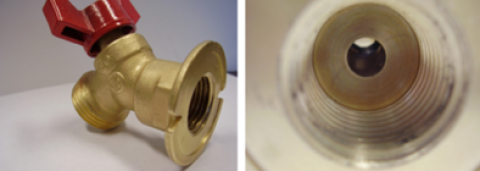 An example of a sill cock faucet with a very small orifice.
What to do? Determine if the new faucet is adequate for your pressure. Note that these faucets can reduce your flow by as much as 25 percent. Also, a small piece of debris may have been dislodged while the water was shut off and it ended up plugging your newly installed faucet. You may have to disassemble the new faucet and check for particles in the valve. Some water-saving faucets reduce the water flow which may be exaggerated by water system pressure that is on the lower end of normal operating pressures.
- Other things to consider when evaluating water pressure at your home.
- Certain pipes in the home can be undersized, especially if you have water system pressure on the lower end of normal operating pressures.
- The house could be set back unusually far from the street and size of the water service is inadequate to prevent "friction loss." Friction loss reduced the amount of flow available.
- If you have an underground irrigation system, there could be too many heads in one zone. Contact your irrigation contractor for more information.
More questions?
Contact the Utilities Division at 952-563-8777 for assistance.
Below is information on water meter flow rates. Flow rate is measured in gallons per minute (gpm).
| Size | Flow rate |
| 3/4" (includes fire detector) | 30 gpm |
| 1" | 50 gpm |
| 1-1/2" | 100 gpm |
| 2" | 160 gpm |
| 2" Turbine with accessories | 200 gpm |
| 3" Turbine with accessories | 500 gpm |
| 4" and above | Not allowed - Contact the Utilities Division |
Intent of standard
The intent of this standard is to apply and enforce provisions of existing City Code and other regulatory rules to minimize the amount of fats, oil, grease and wax entering the City of Bloomington's wastewater collection system. Any new development proposal for a facility that includes commercial food preparation and/or serving shall install and maintain an exterior grease interceptor conforming to Section 5 of this standard. Existing facilities performing commercial food preparation or serving shall operate and maintain any grease removal devices currently in place, and shall follow Best Management practices (BMPs) to eliminate discharge of wastewater laden with fats, oils or grease to City of Bloomington's collection system. Remodeling or expansion of an existing facility may require the installation of an exterior grease interceptor, subject to plan review. In any case, the discharge of wastewater from food preparation activities into the public sewer shall be subject to the following local, regional, and federal regulations.
Bloomington City Code
The following section is related to the Bloomington City Code chapter 11.31 (b).
(6) No person shall discharge or cause to be discharged any of the following described waters or wastes to any public sewer unless such person has obtained a permit from the City Engineer specifically authorizing the discharge of such water or waste and unless the conditions, if any, set forth in the permit have been and are complied with by such person:
- Any waters or other liquid or vapor having a temperature higher than 150 degrees Fahrenheit.
- Any waters or wastes containing fats, wax, grease, or oils, whether emulsified or not, in excess of 100 milligrams per liter or containing substances which may solidify or become viscous at temperatures between 32 and 150 degrees Fahrenheit.
(7) Where pretreatment or flow-equalization facilities and/or where grease, oil, or sand interceptors are provided for any waters or wastes, such facilities and/or interceptors shall be maintained continuously in satisfactory and effective operation by the user thereof and at no expense to the City.
Metropolitan Council - Environmental Services
The following section is related to the Metropolitan Council Environmental Services Waste Discharge Rules §406.00
Prohibited Waste Discharges
No person, except as authorized in a permit, shall discharge or cause to be discharged into public sewers any of the following materials:
406.04: Any wastewater containing fat, wax, tallow, grease, or oil of animal or vegetable origin excess of 100 milligrams per liter, that is likely to solidify, become viscous, or become water insoluble, and likely to cause obstruction to the flow in public sewers or cause interference or pass-through.
406.05: An solid or viscous material in amount which are likely to cause obstruction to the flow in a public sewer or interference with the operation of public sewers.
406.22: Any material discharged to public sewers which is likely to cause interference, pass-through, or operational problems at any Metropolitan Council Treatment plant, or which violates applicable state or federal laws or requirements.
The above rules are supported by authority granted to the Council by Minnesota Statutes 473.504 subd 4, 473.511 subd 2, 473.515, and 473.5155.
Environmental Protection Agency - National Pretreatment Program
The following section is related to the Environmental Protection Agency (EPA) national pretreatment program (40 Cfr 403) controlling fats, oils, and grease discharges from food service establishments.
Section 403.5: of 40 CFR prescribes National pretreatment standards and defines prohibited discharges to Publicly Owned Treatment Works (POTW). More specifically, the Pretreatment Program regulations at 40 CFR 403.5(b)(3) in part prohibits "solid or viscous pollutants in amounts which will cause obstruction" in the POTW and its collection system.
This section is an overview of Grease interceptors and the requirements around design, approval and maintenance.
Design and structural criteria for exterior interceptors
(A) All grease interceptors plans and specifications shall conform to Minnesota Rule 4715.1115 (State Plumbing Code) and be submitted for approval by the City prior to installation. Grease interceptor shall receive flow from kitchen/food preparation fixtures and dish-washing machines only; flow from bathroom, locker room, or food waste grinder fixtures is prohibited.
(B) Interceptor must allow for a 30 minute retention time under actual peak flow as determined by fixture capacity served by grease interceptor.
(C) New in-ground grease interceptors shall not be less than 1,000 gallons total capacity unless otherwise approved by the Utilities Superintendent.
(D) Interceptor must have interior baffles to distribute flow. Baffle wall must be located a distance from inlet wall of two-thirds to three-quarters the total length of structure.
(E) Interceptors must have a minimum 2:1 length to width ratio.
(F) There must be a minimum of six (6) inches of freeboard at grease interceptor top.
(G) Each grease interceptor shall have inlet and outlet tees, or baffles isolating the flow in to and out of the interceptor. The inlet tee or baffle shall extend at least 25 percent into the liquid depth. The outlet tee or baffle shall extend at least 50 percent into the liquid depth. Inlet and outlet tees must be a minimum of four (4) inches in diameter and constructed of plastic. Baffles must have an open area at the top and bottom equal to or greater than 12.5 square inches, and be constructed of plastic or stainless steel.
(H) Each interceptor shall have an access opening over the inlet and outlet (each compartment) within the structure. Each opening shall be at least 24 inches in diameter and be secured in place. All covers shall be constructed of cast iron or equivalent traffic bearing material. Manholes/covers shall extend to finished grade and installed to prevent the inflow of surface or storm water into the interceptor.
(I) Cleanouts shall be installed on the inlet and outlet sides of the interceptor and extended to finished grade, and shall be a minimum of four (4) inches in diameter.
(J) Structure shall have a minimum concrete compressive strength of 3,500 psi.
(K) Grease interceptors must meet a minimum structural design of 150 pounds per square foot for non-traffic installations. For vehicular traffic conditions the grease interceptor shall be designed to withstand an H-20 wheel load.
(L) Grease interceptors shall me the following standards: ASTM C-1227 for Septic Tanks, ASTM C-913 for Precast Water and Wastewater Structures, ACI-318 for Design and ASTM C-890 for establishing minimum Structural Design Loading.
City Approval and Acceptance
By approving a development proposal that includes a grease interceptor design, the City assumes no liability for the failure of a system to adequately pretreat wastewater to achieve effluent quaility requirements that conform to Bloomington City Code, Metropolitan Council Waste Discharge Rules, and 40 CFR 403. It is the responsibility of the owner and design professional to ensure the appropriate level of pretreatment needed to comply with City Code and State Plumbing Code requirements.
Maintenance of grease interceptors
General Policies
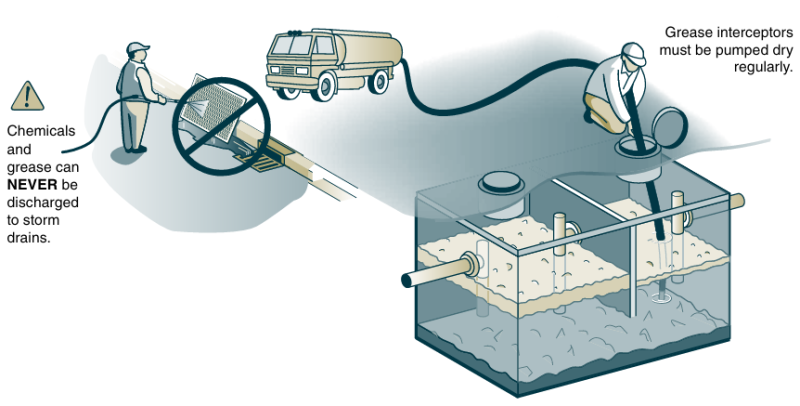
The owner/operator of any grease interceptor installed in the City of Bloomington shall, as provided for in Bloomington City Code, Ch. 11.31 (b)(7), continuously maintain the grease interceptor to ensure effective operation through an inspection interval not to exceed one every three (3) months, (M.T 4715.1115, Subp.3.) and complete pump-out at an interval not to exceed 12 months.
Actual pump-out interval may be more frequent depending on use. At the time application is made for connection to the sanitary sewer system, the owner/operator of the grease interceptor structure shall enter into an agreement to properly maintain said interceptor, and retain maintenance records at the premises for a period of three (3) years. Inspection and pump-out records must be made available to City of Bloomington staff upon requests.
Recommended pumping practices
The owner, manager or employee of the business served by the grease interceptor must require the waste hauling contractor to evacuate all contents, including floating materials, wastewater, bottom sludge and solids. The use of hot water, acids, caustics, solvents or emulsifying agents when cleaning grease interceptors is prohibited.
After pump-out, all accessible interior surfaces of the grease interceptor shall be scraped and then washed down, followed by complete removal of the residue. The attending representative of the business must make a complete and appropriate entry in the grease interceptor maintenance log.
The owner/operator of any grease interceptor in the City of Bloomington must ensure that no removed contents of the interceptor are separated, decanted, backwashed or otherwise placed back into the interceptor.
The owner/operator shall be responsible for ensuring that no waste or wastewater pumped from the grease interceptor is reintroduced back into the collection system, storm sewer, the environment, or is otherwise disposed of improperly.
This is an overview of frequently asked questions related to sanitary sewer maintenance as it relates to food service establishments. This information is a guide to most common questions. It is not intended, nor shall it be considered, a complete set of requirements.
What is the property owner's responsibility?
The owner, operator or leaseholder of a food service establishment is responsible for cleaning, maintenance and repair of the sewer lateral from the building to the City main, including any inspection structures (manholes, cleanouts) prior to connection with the municipal system.
What are some best management practices for fats, oils and grease?
- Use "dry" cleanup methods; scrape grease and food from plates, trays, pots, cookware, utensils and other cooking surfaces into the trash for disposal.
- Do not pour grease down sinks or floor drains. Instead, recycle as much used grease as possible.
- Post "NO GREASE" signs over sinks and floor drains.
- Train all employees on proper handling of used fats, oils and grease.
- Use screens or strainers on sink drains to prevent solids from entering the grease interceptor or the collection system.
Do food service establishments cause any problems in municipal sewer systems?
Operators of wastewater treatment and collection systems are all too familiar with fats, oils and grease discharges commonly associated with restaurants and food handling facilities. Properly sized and maintained grease retention devices on food preparation and dishwashing waste lines, coupled with implementation of Best Management Practices during daily operations, can dramatically reduce fats, oils, and grease buildup in the building sewer and the municipal system.
Is the discharge of fats, oils, and grease to the public sanitary sewer regulated?
Yes, Bloomington City Code, Chapter 11.31(b), Metropolitan Council Environmental Services Rules 406.04, 406.05, and 406.22, and EPA National Pretreatment Program [40 CFR 403.5(b)(3)] specifically prohibit discharge of "solid or viscous pollutants in amounts which will cause obstructions" into the wastewater collection system.
Are there any other strategies I can employ to reduce fats, oils and grease discharge?
Food service establishments are responsible for minimizing the amount of fats, oils and grease entering the City of Bloomington collection system.
Follow the below self-assessment checklist to see if your business is properly managing your discharge.
- Are all employees trained on Best Management Practices for fats, oils and grease handling, cleanup and storage?
- Do employees remove food waste with "dry" clean-up methods, such as scraping, wiping or sweeping, before using "wet" methods that use water and detergent?
- Does your business have a grease trap (inside) or interceptor (outside) to ensure wastewater discharges do not exceed current City of Bloomington limits (100 mg/L) for fats, oils and grease?
- Is your grease trap or interceptor being cleaned by staff or a contractor on a regular basis, and are records of inspection and maintenance being kept?
- Are exhaust hood filters, floor mats, floors and grills cleaned so that wastewater does not reach the sewer without first passing through a grease trap or interceptor?
The Bloomington Utilities Division issues permits for the installation of water, sanitary sewer and storm sewer utility lines that are underground, generally outside the building footprint. Inside plumbing permits are handled by the Building and Inspections Division at Civic Plaza.
All work must be done by a plumber licensed by the State of Minnesota and registered with the City of Bloomington or by the homeowner of the homesteaded property. A homeowner is not allowed to install water and sewer services for a new construction. A pipe layers card is not sufficient for obtaining Utility permits.
Special Notes
- City of Bloomington water and sewer specifications may differ from other communities. Do not assume that the material and standards used elsewhere can be used in Bloomington. Please contact the Utilities Division regarding these requirements.
- Substitution of any material shall be pre-approved by the Utilities Civil Engineer or Utilities Superintendent prior to installation.
- Utility permit holders are required by State law to call Gopher State One Call (651-454-0002) to locate storm sewer, sanitary sewer and water lines within the right-of-way, except sanitary sewer services, which are marked only at the connection to the City main.
- The City of Bloomington requires that electronic as-builts of all new sanitary sewer, storm sewer and water infrastructure be submitted within 3 days of project completion.
Permit Requirements
- Plans must be approved and permits issued from Building and Inspections for new construction permits.
- Service Availability Charge (SAC) for sanitary sewer and utility connection charges must be paid before work can begin.
- A permit application, showing proposed locations of mains, services, appurtenances and other property placed, shall be submitted to Utilities for approval.
- A cop of the approved permit, including a map or plan showing the location of the utility, must be on the job site in possession of the permittee. Failure to have the permit on the job may result in a shutdown.
- Emergency utility repairs involving excavations are allowed without a permit, but you must follow Gopher State One Call guidelines as required by the State of Minnesota. A permit shall be requested within two working days thereafter.
Specifications
See the Engineering Division's Supplemental Specifications to Standard Utilities Specifications and Utilities Division Connection Regulations.
Right-of-way-Permit
- A permit must be issued from the Utilities Division for work in the right-of-wat.
- The Contractor is responsible for traffic control during any excavation and until the roadway surface is restored (per Appendix B of the MN Manual on Uniform Traffic Control Devices). If excavating on a high volume roadway, traffic control must be approved by the Traffic Section prior to any construction.
- Restoration: Underground work must be restored with suitable material and compacted to a density of 95 percent of Standard Proctor. One of more density tests shall be taken on every street crossing and may be required in other excavations as designated by the Public Works representative. The Contractor must provide written results of the density test(s) to the City. Failure of test could result in re-excavation and recompaction of work area. Permanent restoration is required within five days. Consult the Right-of Way Ordinance in the City Code, Chapter 17, Article IV.
Inspections
All work must be inspected after each structure installation and upon completion. Call the Utilities Division at 952-563-8777 to schedule an inspection at least 24 hours in advance. Inspection hours are 8:00 am to 3:00 p.m., Monday through Friday.
Installation and material requirements
Use the City Standard Construction Details shown on the plans or available on the City's website for details of installations. Maintain at least 10 foot horizontal separation between water and sewer lines for commercial properties. Water mains crossing sewers shall have a minimum of 18 inches vertical separation. Any field changes in approved plan must be reviewed and information about changes, e.g. length of pipe, provided to the inspector. A ladder shall be provided for access to all excavations.
Sanitary sewer
When making repairs where dissimilar sizes and types of pipes are used, shielded commercial adaptors shall be used. Flex couplings are not allowed Stainless steel banded couplings are not allowed. Stainless steel banded couplings must be used to make repairs in existing sewer services. Insulate shallow lines to prevent freezing. Materials and methods for sewer repairs must be approved by City staff prior to work. The minimum grade for building sewers shall be 1 percent for a 4 inch diameter pipe, 0.5 percent for a 6 inch pipe, 0.4 percent for a 8 inch pipe and .22 percent for a 12 inch pipe.
Commercial sewers - Use standard short cone MHs with center holes only per MNDOT spec S.P. 4010 placed on 6 inch sand or suitable foundation material. Pipe connections into MHs must be watertight (MNDOT S.P 40/OH). SDR35 PVC is allowed for sewer mains 6 inches and larger, but SDR35 PVC in any size not allowed under building footings. Tracer wire on plastic sanitary sewer service is mandatory.
Residential sewers - Use schedule 40, SDR 26 or better for PVC sewer services. Common trench installations with a water service require the sewer to be 1 foot below and 1 foot to the side of the water service. Use of tracer wire on plastic sewer service is recommended.
Storm Sewer
All storm sewer work requires approval by the City Water Resources Engineer. Erosion control must be kept in place around inlets until ground surface is restored. RCP is required under paved areas subject to vehicle traffic. MH and CB bases shall be set on 6 inch sand or suitable foundation material. Structures shall have a minimum of 2 and a maximum of 6 adjusting rings set in a bed of mortar.
Water
Provide a minimum 8 feet and maximum 10 feet of cover on all water lines, valves, services, etc. All cooper pipe connections shall have standard fittings using flared joints (no silver-soldered joints). Copper shall be Type K. Plastic water service tubing is approved for use only on private property. Materials must be approved by Utility Division Staff and a tracer wire must be placed in the trench with the service line. Water curb stops and gate valves shall be operated by City personnel only, unless authorized by the inspector.
Commercial water lines - Use Class 56 for 4 inch DIP, Class 55 for 6 inch DIP, Class 54 for 8 inch DIP and Class 53 for 12 inch DIP. Polywrap (8 mil thickness) all DIP, valves and hydrants up to the surface. Poured-in-place thrust blocks are required on all DIP Tees and bends greater than 11-1/4 degrees. City forces shall do taps of live water mains. All DIP pipe and fittings up to the water meter or fire service equipment shall have cement-mortar linins or epoxy coatings as per AWWA Standards C104 or C116. DIP services must terminate with a thread on flange or a MJ to flange adaptor. These are a few of the notable material and installation requirements.
Residential water lines - Services shall be brought through the floor vertically with a full flow valve placed between the meter and the floor, the meter installed horizontally about 12 inches above the floor and a full flow valve on the house side of the meter. Water lines shall be 1 foot above and 1 foot to the side of sewer lines in the same trench.
Utility Permit Types and costs
Different Utility permits are issued depending on the type of work as follows:
| Permit | Description |
| Water | New/remodel construction. Involves installation of new water service line from water main to building |
| Sewer | New/remodel construction. Involves installation of new sewer service line from sewer main to building. |
| Water repair/alteration | Modification to existing water service line. |
| Sewer repair/alteration | Modification to existing sewer service line. |
| Storm sewer | Installation/modification of storm sewer. |
| Irrigation | Establish new irrigation account on new or existing water service line. |
| Fire service | Establish fire service account on water service line. |
| Abandon/cut off services | Abandon (permanent) or cutoff (temporary) water and sewer services. |
| Water meter | Metering water usage of lines connected to City water supply. |
| Hydrant Meter | Temporary use of City fire hydrants. 90-day limit. |
Note: Additional permits may be required for commercial developments with multiple structures.
Any questions on Utility permitting please contact the Utilities Division at 952-563-8777.
This section is an overview of the inspection and testing requirements.
Please note that in all cases, City of Bloomington Standard Specifications and Utility Connection Regulations will prevail. It is the contractor's responsibility to know requirements before starting project. Ask before doing work if you are not sure.
| Type of work | Inspection required | Testing required |
Sanitary Sewer | ||
| Alteration/Repair | Visual inspection of pipe material, bedding, bends, alignment and connection to existing pipe. Reline 6 inch clay service. | Air test needed if repair exceeds 20 lineal feet of pipe. |
| Cut off/disconnect | Visual inspection of plug/cap/bulkhead. | None. |
| Manhole installation | 6" sand or suitable foundation material. No steps in MH. Visual inspection for proper invert, casting, rings, cone section and cover. | None. |
| Mainline | Visual inspection of pipe grade, bedding, alignment, connections of dissimilar pipes or casting. | Air testing: >3.6 psi for 2 minutes (4"), 3 minutes (6") or 4 minutes (8"). Mandrel after 30 days for a pipe 8 inches and larger that are >39 lineal feet. |
| Service line | Visual inspection of pipe grade, bedding, bends, connections of dissimilar pipes and alignment. | Air testing: >3.6 psi for 2 minutes (4"), 3 minutes (6") or 4 minutes (8"). |
Storm sewer | ||
| Alteration/repair | Visual inspection before backfilling. | None. |
| Cut off/disconnect | Visual inspection of bulkhead. | None. |
| Manhole/catch basin installation | Visual inspection of 3" concrete under precast base. Visual inspection of proper invert, doghouses, rings/casting construction. | None. |
| Mainline | Visual inspection of pipe bedding and alignment. | None |
Water | ||
| Abandon service | Water meters returned to City. Visual inspection of corp, plug, cap or valve. Check for leaks under main pressure, thrust restraint of large services. Verify valve box pulled. | None. |
| Alteration/repair | Visual inspection of bedding, alignment, fittings, thrust blocks and polywrap on DIP. Check for proper pipe class. | Hydrostatic (150 psi / 2 hrs), conductivity (350 amps / 5 mins), bacteria test. |
| Cut off/disconnect | Meters returned to City. Visual inspection of cut/crimped copper or CIP/DIP. Check for proper pipe class. | None. |
| Fire service | Visual inspection of pipe bedding, fittings, thrust blocks, polywrap and alignment before backfilling. Check for proper pipe class. | Hydrostatic (200 psi / 2 hrs), conductivity (350 amps / 5 min), bacteria test. |
| Irrigation service | Inspect curbstop, boot, standpipe and unions | System pressure or air test. |
| Mainline | Visual inspection of pipe bedding, fittings, thrust blocks, polywrap and alignment before backfilling. Check proper pipe class. | Hydrostatic (150 psi / 2 hrs), conductivity (350 amps / 5 min), bacteria test. |
| Meter manhole | Visual inspection of MH placement. | None. |
| Service line-copper | Inspect curb stop, boot, standpipe, unions and verify that type K copper was used. | System pressure or air test (75 psi / 5 min) |
| Service line - DIP | Visual inspection of pipe bedding, fittings, thrust blocks, polywrap and alignment before backfilling. Check for proper pipe class. | Hydrostatic (150 psi / 2 hrs), conductivity (350 amps / 5 min), bacteria test. |
| Service line - plastic | Plastic allowed on private property only. Tubing must be bedded in sand and have a tracer installed from curbstop into building. | System pressure or air test (75 psi / 5 min). |
| Valve | Visual inspection of proper bedding, block under valve, boot placement and polywrap. Is valve operable after backfilling? | Hydrostatic (150 psi / 2 hrs), conductivity (350 amps / 5 min). |
Water meters | ||
| Domestic service | Must be in utility or mechanical area within 4 feet of floor drain, set at proper height. Must be wired to outside touch pad (residential). Curbstop up to grade and operable before water turned on. | Commercial meters tested as part of service line. |
| Fire detector check | Installed horizontal between tapped ports in detector check valve body. Gate or ball valve on supply side of meter and double check valve on system side of meter. | Tested as part of fire service line. |
| Irrigation | Confirm it is plumbed before the domestic meter. Must be in utility or mechanical area within 4 feet of floor drain | None. |
| Hydrant meters | For filling tank trucks, tank must be inspected for air gap or approved backflow preventer prior to obtaining permit. | None. |
Questions?
Contact the Utilities Division at 952-563-8777.