Recreational Vehicles
Note: Information contained within handout intended for single-family residential properties. Consult City staff for other property types.
- Vehicles used for camping or temporary living quarters, whether self-propelled, drawn, towed, or carried.
- A non-motorized trailer intended and generally used for transporting recreational vehicles such as boats or snowmobiles.
- A truck with a slide-in camper that is not used primarily for day-to-day transportation needs.
- Snowmobiles, all-terrain vehicles, any type of watercraft and similar vehicles.
- Hobby vehicles.
Class I: A recreational vehicle with a length of less than 20 feet and a height of less than six feet when measured from the parking surface to the highest point of the vehicle.
Class II: A recreational vehicle with a length of 20 feet or more or a height of six feet or more.
Vehicles longer than 40 feet are prohibited.
- In front or side yards abutting streets the recreational vehicle must not extend more than eight feet in front of the wall plane of the dwelling facing a street unless it meets additional standards (see next page).
- In side yards not abutting a street, the recreational vehicle must be set back at least five feet from any side lot line not abutting a street.
- In rear yards, a Class I recreational vehicle must be set back at least five feet from any rear lot line not abutting a street and at least 30 feet from any rear lot line abutting a street. A Class II recreational vehicle must be set back at least 30 feet from any rear lot line, except that recreational vehicles may be set back as little as five feet from any rear lot line in areas where the recreational vehicle would be entirely between two garages on abutting sites.
Storage illustrations
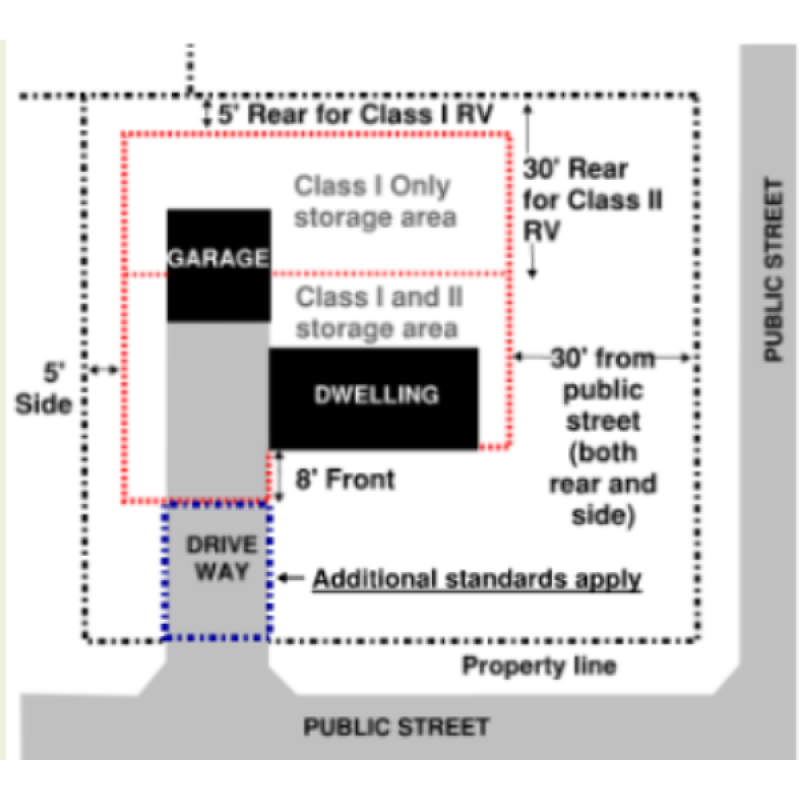
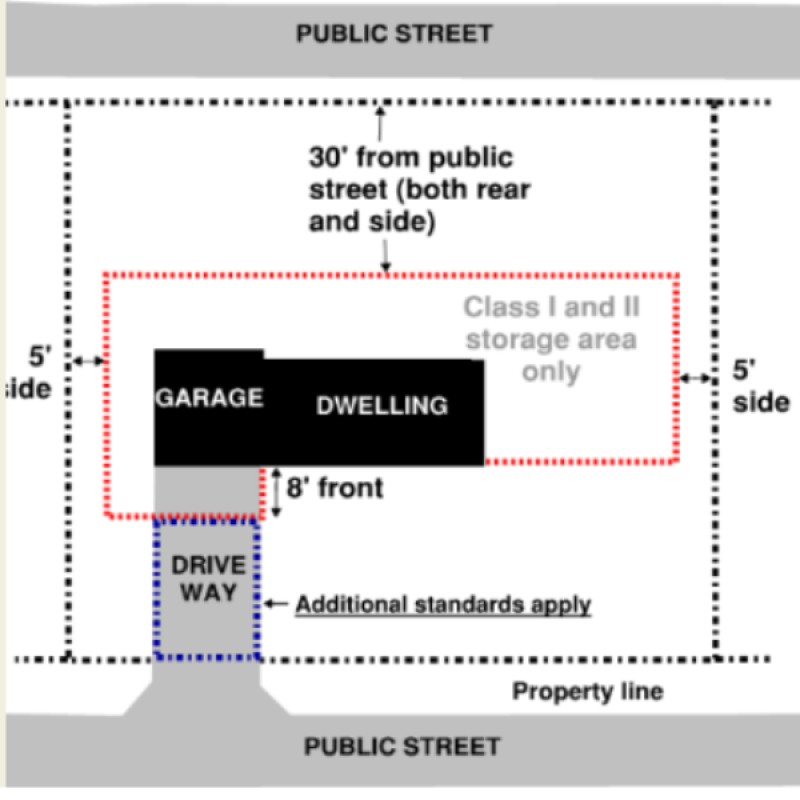
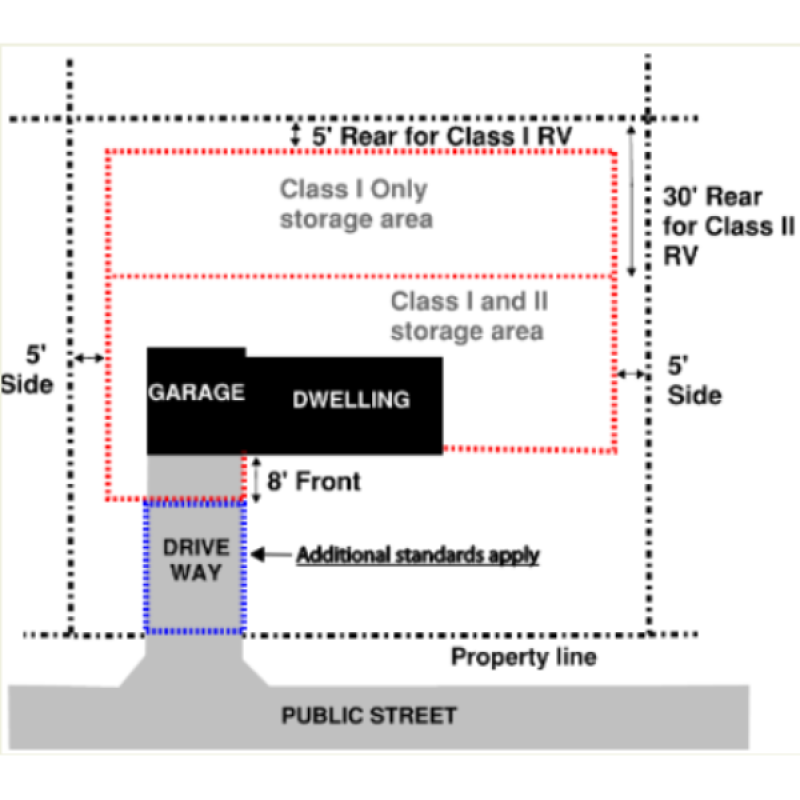
The following diagrams illustrate typical locations on different lot types where recreational vehicles may be stored in compliance with the setback standards described above.
Corner Lot:
- Lot feature: Rear along public street
- Minimum setback for Class I RV: 5 feet
- Minimum setback for Class II RV: 30 feet
- Lot feature: Side along public street
- Minimum setback for Class I RV: 5 feet
- Minimum setback for Class II RV: 30 feet
- Lot feature: Front
- Minimum setback for Class I RV: 8 feet in front of dwelling wall plane (subject to additional standards)
- Minimum setback for Class II RV: 8 feet in front of dwelling wall plane (subject to additional standards)
Through Lot
- Lot feature: From each public street
- Minimum setback for Class I and II RVs: 30 feet
- Let feature: Side lot lines
- Minimum setback for Class I and II RVs: 5 feet
Interior Lot
- Lot feature: Rear lot line
- Minimum setback for Class I RV: 5 feet
- Minimum setback for Classy II RV: 30 feet
- Lot feature: Side lot lines
- Minimum setback for Class I RV: 5 feet
- Minimum setback for Classy II RV: 5 feet
- Lot feature: Front
- Minimum setback for Class I RV: 8 feet in front of dwelling wall plane (subject to additional standards)
- Minimum setback for Classy II RV: 8 feet in front of dwelling wall plane (subject to additional standards)
If the recreational vehicle extends more than eight feet in front of the dwelling wall plane facing a street it must meet the following additional standards:
- Must be set back at least five feet from any property line, at least ten feet from any sidewalk, and at least 20 feet from the back side of any street curb or edge of pavement;
- Must not exceed 11 feet in height at any point. When measuring height for this subsection, appendages including but not limited to HVAC units, antennas, and unextended masts are not included;
- Must not exceed 25 feet in length, including trailers. When measuring length for this subsection, appendages including but not limited to motors, spare tires, hitches and trailer tongues are not included;
- Must be parked or stored no more than 30 feet closer to the street than the principal building on the same site;
- Must be parked or stored on a conforming or legally nonconforming driveway or off-drive parking area; and
- Subject to the following seasonal storage restrictions
- During the months of November through March, storage of summer oriented recreational vehicles is prohibited;
- During the months of May through October, storage of winter oriented recreational vehicles (including but not limited to snowmobiles and ice fishing oriented recreational vehicles) is prohibited;
- Recreational vehicles that are both summer and winter oriented are not subject to seasonal storage restrictions provided all other applicable standards are met
No seasonal restrictions apply during the month of April
Except when more than eight feet in front of a dwelling, visual screening in the form of a fence or plantings must be provided where the recreational vehicle is readily visible from abutting properties. A recreational vehicle is considered visible if more than 50% of the horizontal length can be viewed from a primary dwelling.
All recreational vehicles parked or stored must be owned or leased by an occupant of the site where parked or stored. Guests may park recreational vehicles on a driveway for a period not exceeding seven days in any consecutive six-month period provided all other standards are met.
Any recreational vehicle less than 40 feet in length may be temporarily parked in the driveway for the sole purpose of loading or unloading and routine maintenance for a period not exceeding 72 hours within seven consecutive days.
A permit is not required to store recreational vehicles in compliance with the City Code.
As many properties are unique, it is difficult to provide all the details in a handout. If you are unsure about a requirement, please call, visit or email City staff for clarification.
- Phone: 952-563-8920
- Email: planning@BloomingtonMN.gov
- In Person: Monday through Friday
8:00am to 4:30pm
City Hall
1800 W. Old Shakopee Rd
Bloomington, MN 55431