Fences Information Sheet
The following information condenses the provisions in Bloomington City Code Section 21.301.08.
Note: See Terms and definitions for explanations of the terms used in this handout.
Fence installations, alterations or repairs do not require a permit, with the following exceptions:
- A fence seven feet or more in height requires a building permit from the Building and Inspection Division before the fence is installed.
- A fence within a floodplain requires a permit from the Building and Inspection Division before installation.
- A fence within a shore area that is not more than 10 feet inland from the ordinary high water level (OHWL) requires a shore area permit from the Building and Inspection Division before installation.
- A fence may not be placed in the right-of-way without approval and an encroachment agreement.
Code requirements apply even if a permit is not required.
Height
The following regulations apply to fence height, subject to the exceptions in the next column. For height requirements, an alley is not considered a street.
Maximum height of fence body within area from property line to setback line
- Yard adjacent to street
- Residential: 4 feet
- Non-residential: 6 feet
- Yard not adjacent to street
- Residential: 6 feet
- Non-residential: 10 feet
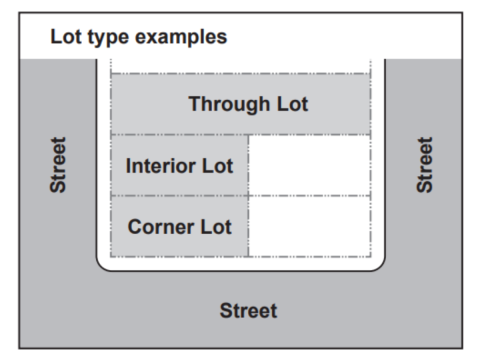
See below for residential lot examples.
Exceptions
- A residential fence in a yard adjacent to an arterial street as designated by the Comprehensive Plan may be a maximum height of six feet. See map on page 4.
- A residential fence that meets the required setback from a specific property line for a principal structure in its zoning district may be eight feet high. A permit is required.
- A residential fence in the rear yard of a corner lot may be six feet high if the fence meets the minimum setback from the street for a principal structure in its zoning district or provided the fence is no closer to the street than the principal structure or garage.
- A residential fence in the rear yard of a through lot when both adjacent lots are also through lots may be six feet high.
- A residential fence adjacent to a nonresidential use may be eight feet high. A permit is required.
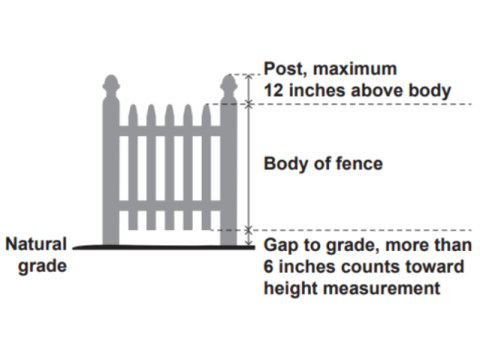
The body of the fence determines the fence height. A maximum of six inches is allowed above the natural grade (e.g., for drainage purposes). Fence posts may extend a maximum of 12 inches above the body of the fence. If the fence height has been elevated through the use of a retaining wall, the creation of a berm or another method for the primary purpose of increasing the elevation of the fence, the fence height is measured from the ground elevation prior to the grade modification.
Opacity
Fence opacity is the degree to which views are blocked. When a fence adjacent to a street is over three feet in height and does not meet the required setback for a principal structure in the zoning district, fence opacity is limited to 50 percent or less, subject to the exceptions below. See right for examples. For opacity limitations, an alley is not considered a street.
Exceptions
- A fence in a yard adjacent to an arterial street as designated by the Comprehensive Plan, provided a 15-foot clear view triangle is maintained. See page 3 for clear view triangles and page 4 for arterial streets.
- Screening fences required by the City Code, including commercial properties. See Section 21.301.08 (g)(4).
- Screening fences required by a condition of approval for a development application.
- Fences in the rear yard of a through lot when adjacent lots are also through lots. See through lot example on page 1.
- Fences in the rear yard of a corner lot when the fence is no closer to the street than an existing principal structure or garage.
- Vegetation growing adjacent to or on a fence will not be considered in determining compliance with the opacity requirements for fences.
Approved materials
Fences must be constructed of wood, metal, bricks, masonry, plastic, or other materials designed for permanent outdoor fencing. Wood fences must be constructed of cedar, redwood, or other decay resistant wood. Chain link fencing finer than 11-gauge in diameter is prohibited. (Note: 12-gauge is finer and 10-gauge wire is thicker than 11-gauge.) Fences must not be constructed from razor wire, snow fencing, plywood, or materials originally intended for other purposes. Above ground electric fencing is not permitted. Barbed wire is permitted only on top of fences in nonresidential districts, a minimum of six feet above the natural grade.
Exception
Temporary fences made of chicken wire in residential districts are permitted for residential garden uses only.
All fence elements must be permanently installed and constructed in a workmanlike manner to secure the fence in a vertically level position. Fences must be installed so that posts and lateral supports are not on the side of the fence facing an adjacent property or public right-of-way, unless exposed on both sides.
Maintenance
All fences must be kept in good repair and appearance on both sides of the fence by its owner. Peeling, flaking and chipped coating must be eliminated and surfaces recoated. The property owner is responsible for maintaining the area between the property line and the owner's fence.
The following restrictions on fences apply to protect the public health, safety, and welfare.
Ownership
All fences, including fence footings, must be located entirely on the fence owner's property. Property irons or as-built surveys are ways to find the property's dimensions.
Public easements
Fences may not be placed on or extend into a public easement where public improvements are located without approval of an encroachment agreement by the Director of Public Works or designee along with proof that the agreement has been filed with the records for the property in the Office of the Hennepin County Recorder or Registrar of Titles. When installing any part of a permitted fence into a public easement, the City or any agent of the City permitted to use the easement will be held harmless for any and all claims for damage to the fence that might occur when work is performed in the easement. In addition, the City is not responsible or liable for the reinstallation of any fence removed from the easement.
Clear view triangle
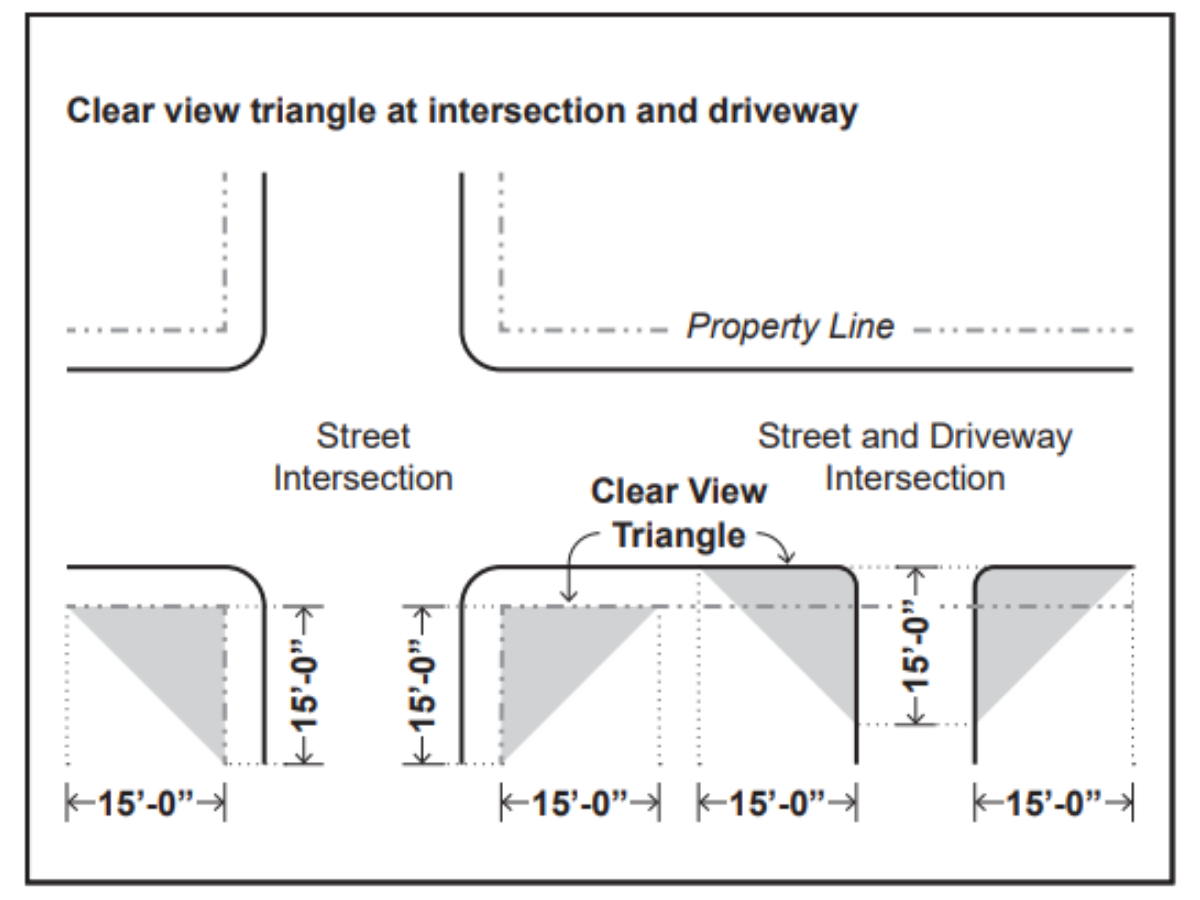
- Fences of any style or material placed on corner lots must maintain a clear view triangle for visibility at the intersection of two streets or at the intersection of an alley and a street (see City Code Section 17.31).
- Fences of any style or material must maintain a clear view triangle from the street curb or street edge, not including alleys, for visibility from driveways on the lot or on an adjacent lot. The clear view triangle area for a driveway is formed on each side of the driveway by measuring a distance of 15 feet along the street curb or edge and 15 feet along the driveway edge. See City Code Section 21.301.08(f)(3).
- Fences must be placed entirely on the fence owner's property, while maintaining the clear view triangle, unless otherwise approved.
Public sidewalks
In addition to clear view triangle requirements, when the property line is adjacent to a public sidewalk, fences must be set back a minimum of two feet from the sidewalk.
Fire hydrant and utility clear zone
The area three feet in radius around fire hydrants, fire hose connections and utility boxes must be kept free of any fencing that could impede use of the hydrant, hose connection or utility box.
Fences in floodways
Fences are not permitted in floodway areas as designated on FEMA's flood boundary and floodway map.
Drainage
A fence must not adversely affect drainage or create debris build-up.

See City Code Sections 14.443 (public pools) and 15.108 (private residential pools).
All fences for licensed public pools must comply with requirements of the State of Minnesota Pool Code, MN Rules 4717.1550.
The property owner is responsible for verifying that no conflicts exist with utilities prior to installation of fencing.
Before digging, call Gopher State One-call at 651-454-0002 to locate utility lines.
Arbors and trellises
Regulations governing fences apply to arbors and trellises used in lieu of a fence or in combination with a fence, except that arbors and trellises used in lieu of a fence may also rise once to a maximum height of nine feet for a distance of six feet in length.
Arbors and trellises are permitted encroachments within required setback areas as provided in City Code Section 21.301.02(g)(4)(G).
Walls used in lieu of fences
Walls
Regulations governing the height, location and opacity of fences apply to walls used in lieu of a fence or in combination with a fence.
- Arbor. An open shelter typically constructed of latticework or exposed boards that often provide partial shade or support for climbing plants.
- Arterial streets. A roadway classification designated in the Bloomington Comprehensive plan. See map below.
- Fence. An artificially constructed barrier enclosing, separating or screening areas of land. A fence may serve as a boundary, a means of protection, a buffer, a decorative element, a way to visually modify the view and/or a confinement area.
- Floodplain. The areas adjoining a watercourse, wetland, lake or water body that have been or may be covered by the regional flood. A floodplain includes the floodway and flood fringe areas.
- Floodway. Any area designated as floodway on the Flood Insurance Rate Map. A floodway is the bed of a wetland or lake, the channel of the watercourse and those portions of the adjoining floodplains that are reasonably required to care, store and discharge the regional flood.
- Flood fringe. The portion of the floodplain outside the floodway.
- Trellis. A frame of latticework used as a screen or as a support for climbing plants.
- Building and Inspection: 952-563-8930
- Environmental Health (Complaints): 952-563-8934
- Planning and Economic Development: 952-563-8920
- Public Works: 952-563-4581