Exterior Lighting Informaiton Sheet
The following is intended to provide general information as to the regulations, permit processes and associated plans for exterior lighting. See Bloomington City Code, Section 21.301.07 for details, exceptions and special standards.
The design standards below are the basic standards required in the City Code and do not encompass all the standards. Some exceptions are noted. Please refer to the City Code for exemptions and specific use regulations. (i.e. Canopy lighting, indoor parking, exterior storage, service station and auto dealers).
Except for single and two-family dwellings, no exterior lighting may be installed prior to approval of a lighting plan by the Issuing Authority. All plans provided to meet minimum light levels must be signed by a registered Electrical Engineer or a Lighting Certified (LC) professional certified by the National Council on Qualifications for the Lighting Professions. The lighting plan must include:
- Name of project and other project staff.
- Date of initial plan preparation and any amendments;
- Scale of plan with North point indication (engineering scale, 1 inch = 50 feet or less);
- An accurate site plan indicating the location of property lines and improvements;
- The location and description of all existing over story landscaping unless a landscape plan is provided;
- The location and height of all lighting on the property;
- Lighting control descriptions and schedule;
- Two separate photometric plans superimposed on a site plan. One with the initial at-grade foot-candle levels and the other the maintained at-grade foot-candle levels. Photometric points must be on a grid ten feet by ten feet or less across the entire site. Each point must be to the nearest 0.1 foot-candle;
- A luminaire schedule table indicating maximum to minimum uniformities for each specific use area such as parking and circulation areas, pedestrian areas, and other common public areas, the type of light source, light source wattage and initial light output lumens rating, color rendering index, color temperature and light loss factor of each lamp source;
- Detailed information on each light fixture including copy of the manufacturers catalog information sheet;
- Minnesota Energy Code Energy use calculations. All parking lots are to be considered as public parking lots in the Minnesota State Energy Code.
All exterior lighting modifications including change of bulb type, ballast, optics or other components which are not identical in manufacturer and specification on the approved plan require a plan review be completed. All exterior lighting, other than maintenance such as bulb, ballast or optics replacements, require an electrical permit be obtained prior to completing the work. An Electrical Permit for exterior lighting can not be approved without a Code-complying photometric plan.
- Facade lighting: Must not to exceed 22,500 lumens (upward) or 45,000 lumens (downward) per source and must be fully shielded from public view. The total watts per square foot of a facade are regulated.
- Flags: Lighting of flags must be recessed into the ground and is limited to no more than three fixtures with a maximum 40,000 lumens combined for poles under 35 feet high.
- Canopy lighting: Must be flush mounted or recessed with no greater than 85 degree from vertical cut-off. No drop down lense is permitted.
- Building entrances and exits: All access points must be illuminated with a light source.
All exterior lighting, other than approved architectural lighting or as allowed for zero cut-off light sources, must have a 90 degree cut-off and flat lenses.
All lights required for security must be on an alternate circuit. All other exterior lighting must be illuminated no earlier than one hour before the start of business and must be extinguished no later than one hour after the end of business.
Prior to the installation of outdoor lighting, an inspection to verify delivery of the approved lamp, fixture, and pole heights must be completed. Before a Certificate of Occupancy may be issued, a post-installation inspection by the Issuing Authority must verify compliance with the approved plan depicting the initial foot-candles levels. Individual points may not vary more than 20 percent with the average of all points within 10 percent of the initial foot-candle level on the approved plans. Any deviation beyond these criteria must be remedied prior to the issuance of a Certificate of Occupancy.
Note: The information below is for the most common application and uses. There are detailed requirements for uses such as parking garages, service stations, auto dealers and other uses. Please refer to City Code, Section 21.301.07 for unique uses. All lighting within 300 feet of a residential use or zone shall meet the height and lumen restrictions in the residential standards.
- Parking lot (internal as measured on the surface)
- Retail/commercial uses:2.0 FC maintained
- Office uses: 1.5 FC maintained
- Residential uses/zones: 1.0 FC maintained
- Parking lot (perimeter 25 feet - as measured on the surface)
- Retail/commercial uses: 1.0 FC maintained
- Office uses: 0.75 FC maintained
- Residential uses/zones: 0.5 FC maintained
- Maximum lumens per light source (shielded)
- Retail/commercial uses: 50,000 lumens
- Office uses: 50,000 lumens
- Residential uses/zones: 30,000 lumens
- Maximum lumens per light source (unshielded)
- Retail/commercial uses: 6,000 lumens
- Office uses: 6,000 lumens
- Residential uses/zones: 3,000 lumens
- Maximum mounting height
- Retail/commercial uses: 33 feet
- Office uses: 33 feet
- Residential uses/zones: 28 feet
- Primary building entrances
- Retail/commercial uses:10 FC within 15 feet
- Office uses: 10 FC within 10 feet
- Residential uses/zones: 5 FC within 5 feet
- Secondary building entrances
- Retail/commercial uses:2 FC within 5 feet
- Office uses: 2 FC within 5 feet
- Residential uses/zones: 2 FC within 3 feet
- Maximum/minimum uniformity ratio
- 10 max: 1 min
- 10 max: 1 min
- 6 max: 1 min
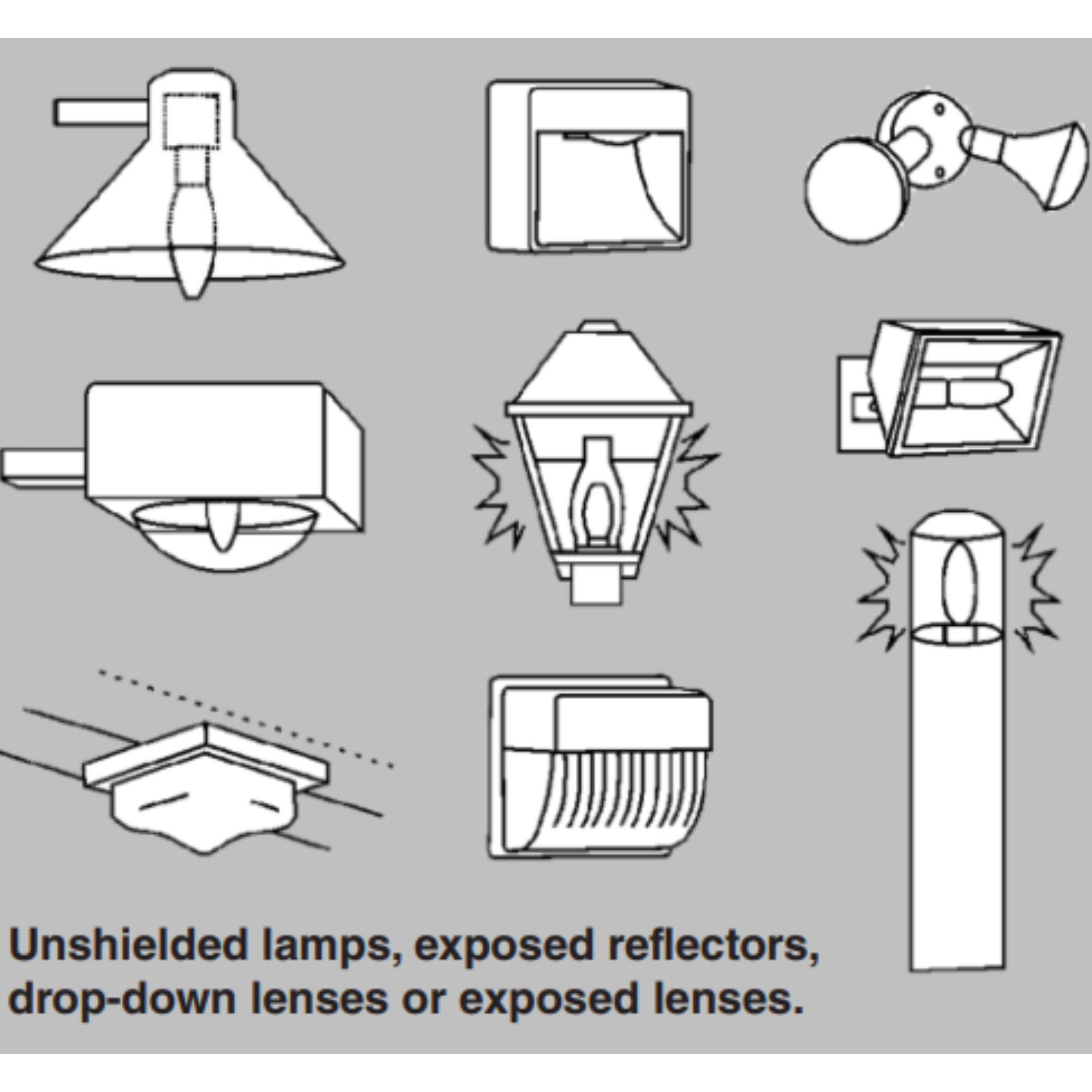
Not Permitted:
Unless the fixture meets the minimum lighting permitted for unshielded fixtures. See below
Prohibited lighting
The following lighting is prohibited unless approved as architectural lighting:
- Lights with a color rendition index of less than 50;
- Lights with a color temperature of less than 2,500 K;
- Blinking, flashing, moving, revolving, flickering, changing intensity or color, and chase lighting, except lighting for temporary seasonal displays, lighting for public safety or required for air traffic safety;
- Any light fixture that may be confused with or construed as a traffic control device; and
- Any upward oriented lighting, including searchlights, beacons, and laser source light fixtures.
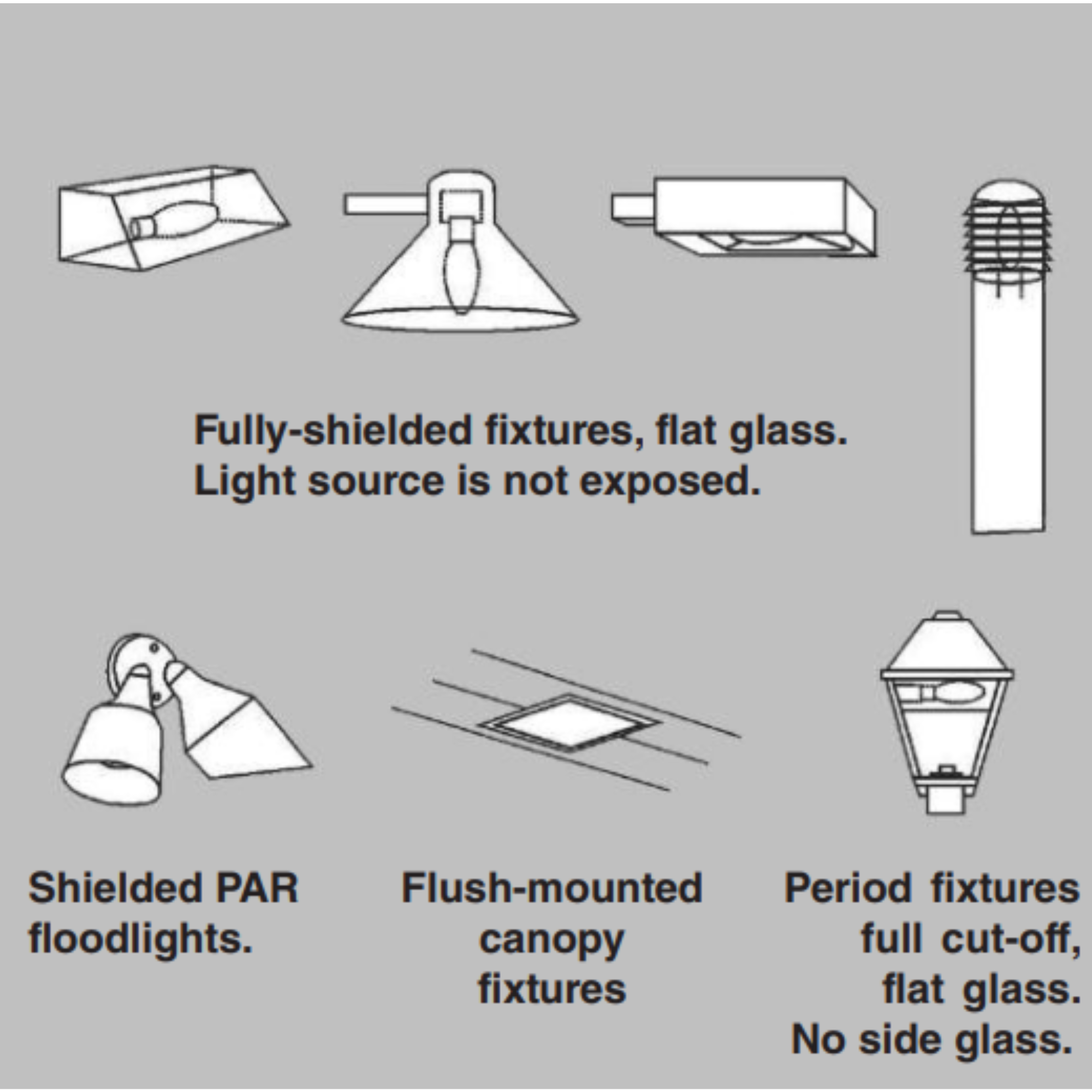
Permitted
Permitted lighting
- Fully-shielded fixtures, flat glass. Light source is not exposed;
- Shielded PAR floodlights;
- Flush-mounted canopy fixtures;
- Period fixtures full cut-off, flat glass. No side glass.