
Title
Temporary Food License Requirements
Widgets
The Environmental Health Division must be notified of all events that involve food service and sampling of food. Contact our office at least 10 business days prior to an event to determine if a Temporary Food License is necessary.
If a license is necessary, an application and a short interview process will follow. The Bloomington City Code adopts the Minnesota Food Code. Final approval must be obtained before the event can take place.
Sanitary Facilities
- Areas of food preparation, service or storage must provide protection against adverse weather, wind or dust. Provide a floor such as plywood or mats if set up on grass, gravel or dirt.
- Water must be obtained from a public supply and must be stored in a sanitary manner.
- Wastewater must be discharged directly to an approved system or holding tank.
- Garbage/refuse must be stored in a covered, leakproof container away from food activities.
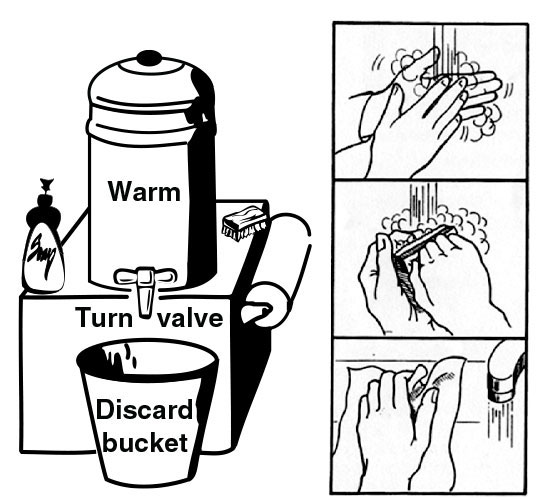
- Handwashing facilities must be provided with running water (a container with a spigot is permitted), nailbrush, pump soap and paper towels. Discharge water into a holding vessel or waste line. Illustrated on page.
Food/food protection
- Food/ice must be obtained from an approved commercial source. Home prepared food is not permitted.
- Food/ice must be covered and stored in a sanitary manner at least six inches above the floor/ground.
- TCS food must be held at 41° F or colder or at 135° F or hotter. Mechanical refrigeration must be used for events over four hours.
- TCS food previously heated must be reheated to 165° F and held at 135° F or hotter.
- Ice used for storing canned/bottled beverages must be self-draining and not be consumed.
- Self-service food condiments must be individually packaged or dispensed from an enclosed dispenser.
- No bare hand contact with ready to eat foods. Use utensils or gloves to handle food that will not be cooked.
- Mark time when using time alone as the public health control.
- A food thermometer must be provided to test food temperatures (0-220° F).
Personnel
- Employees must wash their hands before handling food, after handling raw meat and after eating, drinking, smoking or using the toilet.
- Employees must not have vomiting, diarrhea or sore throat with fever. Employees' hands must be free of cuts, bandages or jewelry.
- No eating, drinking, smoking or chewing gum in the food prep/service area.
- Employees must wear caps, hairnets or other effective hair restraints during food activities and warewashing. Employees must wear clean clothes and aprons over outer garments.
Food equipment/utensils
- Equipment/utensils must be commercial-grade. Crock pots/slow cookers are not allowed.
- Food contact surfaces must be clean and sanitized before each use.
- Sanitizing solution (50-200 ppm chlorine or 200-400 ppm quaternary ammonium) must be used for sanitizing surfaces and dishes. Wet wiping cloths must be stored in a sanitizing solution. Provide appropriate test strips.
- Equipment/utensils must be stored in a sanitary manner at least six inches above the floor/ground.
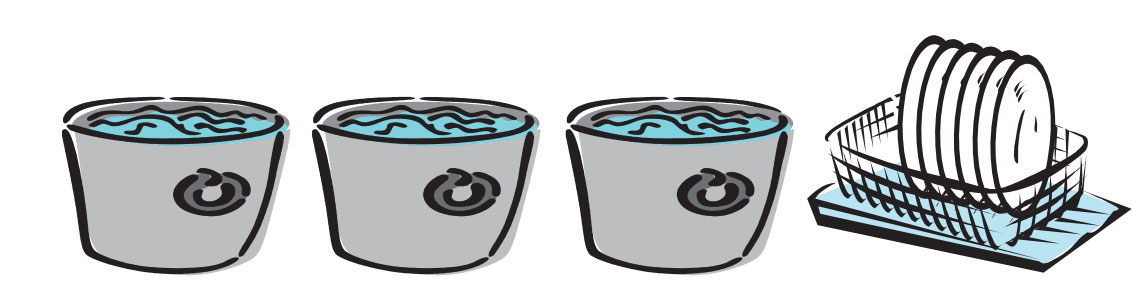
- Dishes/pots/pans/utensils must be washed, rinsed with clear water, sanitized and air-dried. Towel drying is not permitted. Provide three labeled buckets big enough to accommodate the largest utensil.
Sanitizing steps
- Wash: Dishsoap, warm water
- Rinse: Warm water
- Sanitize: Bleach 50-200 ppm or quaternary ammonium 200-400 ppm
- Air dry
Contact Information
Environmental Health
1800 W. Old Shakopee Road
Bloomington, MN 55431
Bloomington, MN 55431
PH:
Email: